
Many brands struggle to control how artificial intelligence systems portray them in global conversations. For Digital marketing professionals aiming to shape perception and improve recognition on platforms like ChatGPT, understanding the mechanics of AI visibility strategy is vital. This guide breaks down actionable steps from persona definition to ongoing monitoring, helping you identify and fill branding gaps, tailor content, and track how your organisation is referenced and understood by AI worldwide.
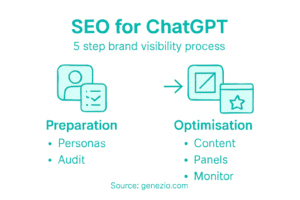
Quick Summary
| Key Point | Explanation |
| 1. Create Detailed Target Personas | Develop personas based on demographics, habits, and needs to understand audience interactions with AI platforms. |
| 2. Optimise Content for AI Readability | Structure brand narratives clearly to ensure they are easily interpreted and referenced by AI systems. |
| 3. Regularly Audit Digital Presence | Maintain consistent, accurate information across online profiles to enhance credibility with AI systems. |
| 4. Simulate Conversations for Insight | Test various AI dialogue scenarios to identify how your brand is perceived and ensure effective communication. |
| 5. Implement Monitoring Tools for Analysis | Use monitoring tools to quantitatively assess brand visibility and track improvements in AI-driven interactions. |
Step 1: Define target personas and audit AI brand mentions
Building an effective AI visibility strategy begins with creating precise target personas that capture the nuanced ways different audience segments interact with conversational AI platforms. By developing detailed persona profiles, you can systematically map how your brand might be perceived and mentioned across diverse digital interactions.
To construct meaningful personas, start by segmenting your audience based on key demographic, psychographic, and behavioural characteristics. These personas should reflect realistic user archetypes who might engage with AI systems like ChatGPT. Consider factors such as:
- Professional background
- Age range
- Technical sophistication
- Potential information needs
- Language preferences
- Typical conversational contexts
Once you’ve developed these personas, conduct a comprehensive brand perception audit to understand how AI platforms currently reference your organisation. This involves simulating conversations using your defined personas and tracking how your brand is mentioned, compared, or recommended across different scenarios.
Your audit should analyse three critical dimensions: frequency of mentions, context of references, and sentiment of interactions. Pay close attention to how AI models interpret and represent your brand’s identity, looking for potential misalignments or opportunities for improved positioning.
Professional recommendation: Treat your AI brand audit as an ongoing process, regularly updating your personas and monitoring how conversational AI evolves in its representation of your organisation.
Step 2: Optimise brand content for conversational AI
Optimising your brand’s content for conversational AI platforms requires a strategic approach that transforms traditional marketing materials into AI-friendly communication. The goal is to create content that AI systems can easily interpret, reference, and recommend across various digital interactions.
To achieve this, focus on developing clear and concise brand narratives that provide structured, factual information. This involves crafting content that is:
- Highly specific and detail-oriented
- Written in plain, accessible language
- Structured with clear key points
- Semantically rich and contextually relevant
- Easily digestible in short-form formats
Consider preparing content that addresses potential user queries comprehensively. This means anticipating the types of questions your target personas might ask and developing precise, authoritative responses. Academic research on content optimisation suggests creating modular content pieces that can be easily referenced and extracted by AI systems.
Specifically, focus on creating content that demonstrates expertise, provides unique insights, and offers clear value propositions. Avoid overly complex language or jargon that might confuse AI parsing algorithms. Instead, aim for crisp, informative descriptions that capture the essence of your brand’s unique capabilities and perspectives.
AI systems prioritise content that is clear, factual, and directly answers potential user queries.
Professional recommendation: Regularly audit and update your content to ensure it remains current, relevant, and optimised for evolving AI comprehension techniques.
Step 3: Refine knowledge panels and online presence
Refined knowledge panels and a strategic online presence are critical for ensuring your brand appears accurately and compellingly in AI-driven search and conversational interactions. This step involves meticulously crafting your digital footprint to provide AI systems with precise, authoritative information about your organisation.
Begin by auditing your existing online profiles across multiple platforms. Focus on ensuring consistent brand information across various digital touchpoints:
- Google Business Profile
- Professional networking sites
- Industry-specific directories
- Social media platforms
- Company websites
Pay particular attention to key details such as:
- Official company name
- Precise contact information
- Authoritative description
- Current leadership details
- Verified company location
Accurate and consistent information builds credibility with AI knowledge aggregation systems.
Ensure your online content uses structured data markup to help AI systems easily interpret and categorise your brand information. This includes implementing schema.org metadata, which provides explicit context about your organisation’s nature, services, and unique value proposition.
Professional recommendation: Conduct a quarterly audit of your online presence to maintain accuracy and adapt to evolving digital information ecosystems.

Step 4: Simulate AI conversations for brand placement
Simulating AI conversations is a sophisticated strategy to understand and optimise your brand’s visibility across conversational platforms. This critical step involves creating realistic dialogue scenarios to test how artificial intelligence systems interpret and represent your organisational identity.
To effectively simulate conversations, you’ll need to develop comprehensive test scenarios that cover multiple interaction contexts. Advanced AI visibility techniques recommend crafting scenarios that reflect:
- Industry-specific customer queries
- Technical support interactions
- Product comparison discussions
- Problem-solving scenarios
- Exploratory research conversations
When designing these simulations, focus on creating nuanced conversation pathways that reveal how AI platforms might reference your brand. This involves:
- Using multiple persona profiles
- Varying question complexity
- Exploring different conversation angles
- Testing cross-platform interactions
- Tracking response consistency
Effective AI conversation simulation reveals hidden brand perception opportunities and communication gaps.
Pay close attention to the language models’ responses, noting how your brand is positioned, described, and contextualised. Look for patterns in recommendation frequency, sentiment, and contextual accuracy that could impact your digital reputation.
Professional recommendation: Conduct conversation simulations monthly to stay ahead of evolving AI communication dynamics and maintain proactive brand positioning.
Step 5: Verify improvements with monitoring tools
Verifying your brand’s AI visibility requires systematic monitoring and data-driven analysis of your conversational positioning across multiple platforms. This crucial step transforms your strategic efforts into measurable insights that demonstrate tangible improvements in AI-driven brand representation.
Comprehensive AI visibility audits recommend implementing robust monitoring strategies that track multiple performance dimensions:
- Frequency of brand mentions
- Contextual positioning
- Sentiment analysis
- Comparative brand references
- Geographic mention variations
Select monitoring tools that provide granular insights into your brand’s AI representation. Key metrics to track include:
- Recommendation frequency
- Conversation context accuracy
- Semantic positioning
- Cross-platform consistency
- Sentiment trends
Continuous monitoring transforms strategic efforts into quantifiable brand visibility improvements.
Ensure you establish baseline performance metrics before implementing changes, allowing you to measure the direct impact of your optimisation strategies. Compare current performance against historical data to understand the evolution of your brand’s AI presence.
Professional recommendation: Implement quarterly comprehensive audits to maintain a dynamic understanding of your brand’s conversational AI positioning and rapidly adapt to emerging communication trends.
Below is a summary of essential metrics to monitor for conversational AI brand success:
| Metric | What It Measures | Business Value |
| Mention Frequency | Number of times brand is referenced | Assesses brand reach |
| Sentiment Trend | Overall positivity or negativity | Reveals reputation trajectory |
| Context Accuracy | Relevance of brand placement | Ensures message alignment |
| Cross-Platform Consistency | Uniformity across channels | Strengthens brand identity |
Here is a comparison of key AI visibility strategy phases and their typical business outcomes:
| Strategy Phase | Main Activity | Expected Outcome |
| Persona Definition | Create segmented user profiles | Improved targeting precision |
| Content Optimisation | Adapt materials for AI platforms | Enhanced mention relevance |
| Knowledge Panel Refinement | Standardise online brand data | Increased authority and trust |
| Conversation Simulation | Test brand in AI dialogues | Identify perception gaps |
| Monitoring & Verification | Track and analyse AI mentions | Continuous improvement evidence |
Elevate Your Brand Visibility in Conversational AI Today
The challenge of mastering AI visibility in platforms like ChatGPT goes beyond traditional SEO. As highlighted in the article “SEO for ChatGPT: Boost Your Brand in AI Responses,” businesses must navigate complex issues such as monitoring brand mentions, optimising content for conversational AI, and simulating authentic customer interactions using detailed personas. If you want to avoid missing out on critical AI-driven brand opportunities and ensure your organisation is accurately represented, embracing advanced visibility strategies is essential.
Genezio offers the perfect solution. Our AI visibility platform is specifically designed to help you track how often your brand is recommended, cited, or compared across large language models while leveraging realistic personas and geographic data to simulate true-to-life conversations. This means you can continuously audit your brand’s AI presence and adapt quickly to evolving AI communication dynamics.
Discover how Genezio supports brand content optimisation and refines your digital footprint for enhanced AI brand placement.

Take control of your AI brand reputation now with Genezio.
Frequently Asked Questions
How can I define target personas for my brand’s AI visibility strategy?
To define target personas, segment your audience based on demographic, psychographic, and behavioural characteristics. Create detailed profiles that reflect how different user archetypes might interact with AI platforms like ChatGPT.
What steps should I take to optimise my content for conversational AI?
To optimise your content for conversational AI, focus on crafting clear, concise, and structured narratives that directly address potential user queries. Develop factual information that can be easily interpreted by AI systems within 30–60 days to improve your brand’s visibility.
How do I refine my online presence to enhance AI-driven search results?
Refine your online presence by auditing your existing profiles to ensure consistent and accurate brand information across various platforms. Implement structured data markup to help AI systems interpret your content, aiming for a standard update every quarter.
What should I consider when simulating AI conversations for my brand?
When simulating AI conversations, create test scenarios that reflect various customer interactions relevant to your industry. For best results, engage different persona profiles and explore multiple conversation pathways on a monthly basis to uncover insights about your brand’s perception.
How can I verify improvements in my brand’s AI visibility?
To verify improvements in your brand’s AI visibility, establish monitoring strategies that track metrics such as mention frequency and sentiment analysis. Conduct comprehensive audits every quarter to gain measurable insights and adapt your strategies effectively.
What key metrics should I monitor to assess my brand’s success in AI responses?
Monitor metrics such as frequency of brand mentions, sentiment trends, and context accuracy to evaluate your brand’s performance in AI responses. Aim to track these metrics regularly to enhance your brand presence and credibility online.

AI and the Next Generation: Opportunities, Challenges, and Responsibilities

Your AI Isn’t Wrong, It’s Alone: Why Model Disagreement Is the Real Enterprise Risk
SEO for ChatGPT: Boost Your Brand in AI Responses