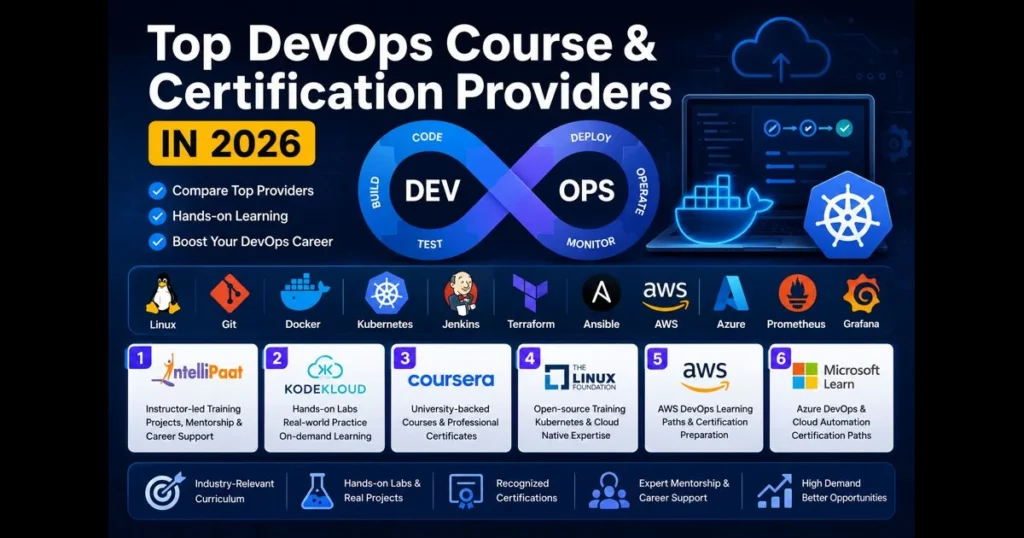
As organizations continue to adopt cloud-native technologies, automation, and continuous software delivery, DevOps has become one of the most sought-after skills in the IT industry. Companies across finance, healthcare, e-commerce, and technology are actively hiring DevOps professionals who can automate infrastructure, manage CI/CD pipelines, and improve software deployment efficiency.
With the growing demand comes an overwhelming number of training providers. From university-backed programs to hands-on learning platforms, choosing the right DevOps course can significantly impact your career growth.
In this article, we’ll compare the top DevOps course and certification providers in 2026 based on curriculum, hands-on learning, certification value, mentorship, and career support.
How We Selected These DevOps Providers
The providers in this list were evaluated based on:
- Industry-relevant DevOps curriculum
- Hands-on labs and real-world projects
- Coverage of modern DevOps tools
- Instructor expertise
- Flexibility for working professionals
- Certification recognition
- Career assistance and mentorship
Top DevOps Course & Certification Providers in 2026
1. Intellipaat DevOps Course
The Intellipaat DevOps Online Course is designed for beginners, software developers, system administrators, and cloud professionals looking to build job-ready DevOps skills. The program covers the complete DevOps lifecycle, including Linux, Git, Docker, Kubernetes, Jenkins, Terraform, Ansible, AWS, CI/CD, monitoring with Prometheus and Grafana, and Infrastructure as Code.
A major advantage of the course is its emphasis on practical learning through live instructor-led classes, cloud labs, industry projects, and capstone assignments. Learners also receive mentorship, interview preparation, resume guidance, and career support, making it a strong option for professionals planning a DevOps career transition.
Best For:
- Beginners
- Working professionals
- Cloud engineers
- Software developers
- Career switchers
2. KodeKloud
KodeKloud has become one of the most popular platforms for learning DevOps through hands-on practice. Its interactive labs allow learners to work with Docker, Kubernetes, Jenkins, Terraform, Ansible, and cloud technologies in real environments instead of relying solely on video lectures. It is particularly popular among learners preparing for Kubernetes and Linux certifications.
Best For:
- Self-paced learners
- Kubernetes certification preparation
- Hands-on practice
3. Coursera
Coursera partners with leading universities and technology companies to offer structured DevOps and cloud engineering programs. Many courses include peer-reviewed assignments, guided projects, and professional certificates covering CI/CD, cloud computing, containers, and DevOps fundamentals.
Best For:
- University-backed learning
- Professional certificates
- Flexible online education
4. Linux Foundation Training
The Linux Foundation offers official training programs covering Linux administration, Kubernetes, cloud-native technologies, containers, and open-source DevOps tools. Since Kubernetes is maintained by the Cloud Native Computing Foundation (CNCF), Linux Foundation courses are highly respected among DevOps professionals.
Best For:
- Open-source technologies
- Kubernetes learners
- Enterprise DevOps professionals
5. AWS Skill Builder
AWS Skill Builder provides learning paths for professionals who want to specialize in AWS DevOps services. The platform covers infrastructure automation, CI/CD pipelines, container orchestration, monitoring, security, and AWS deployment services. It also helps learners prepare for the AWS Certified DevOps Engineer – Professional certification.
Best For:
- AWS professionals
- Cloud engineers
- DevOps on AWS
6. Microsoft Learn
Microsoft Learn offers free learning paths for Azure DevOps, GitHub Actions, Azure Kubernetes Service (AKS), Azure Pipelines, Infrastructure as Code, and cloud automation. The platform is especially valuable for professionals preparing for Microsoft Azure certifications and working in Azure-based enterprise environments.
Best For:
- Azure professionals
- Microsoft certification candidates
- Enterprise cloud engineers
What Should a Good DevOps Course Include?
A comprehensive DevOps course should cover:
- Linux Administration
- Networking Fundamentals
- Git and GitHub
- Shell Scripting
- Python Basics
- Jenkins
- Docker
- Kubernetes
- Terraform
- Ansible
- AWS, Azure, or Google Cloud
- CI/CD Pipelines
- Monitoring with Prometheus and Grafana
- Infrastructure as Code
- DevSecOps fundamentals
- Real-world capstone projects
Hands-on projects are just as important as theory because employers expect candidates to demonstrate practical experience with modern DevOps tools.
Which DevOps Certification Should You Choose?
The right certification depends on your career goals.
- Beginners should focus on learning DevOps fundamentals through a structured training program.
- Professionals working with AWS can pursue the AWS Certified DevOps Engineer – Professional certification.
- Kubernetes administrators may benefit from CKA (Certified Kubernetes Administrator).
- Azure professionals can explore Microsoft Azure DevOps certifications.
- Linux administrators can strengthen their profiles with Linux Foundation certifications.
Choosing a course that combines practical projects with certification preparation can provide a stronger learning experience.
Final Thoughts
DevOps continues to be one of the fastest-growing career paths in IT, and selecting the right learning platform can make a significant difference in your professional journey. The best providers combine industry-relevant curriculum, hands-on labs, experienced instructors, and real-world projects to help learners build practical skills.