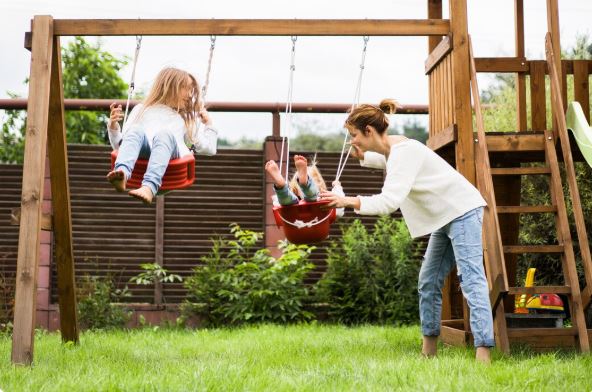
Children move less than they should. The World Health Organisation says kids aged 5 to 17 need at least 60 minutes of physical activity every day. Most fall short. Community spaces can fix this. Commercial outdoor swings are one of the most effective tools for getting children moving in public parks, schools, and recreational areas. They appeal across ages, encourage social interaction, and develop real physical skills. Swings are not passive play. They are full-body movement machines that children choose again and again.
Why Do Children Keep Coming Back to Swings?
Swings give children a sensation they cannot get anywhere else. The arc motion stimulates the vestibular system, which controls balance and spatial awareness. Every swing back and forward sends signals through the inner ear to the brain. Children’s brains actively seek this input. It is literally addictive in a healthy way. That is why a child who has been swinging for 20 minutes will ask for five more minutes without fail.
Research from the Sensory Processing Foundation shows that vestibular input through rhythmic motion calms the nervous system. Anxious children often choose swings first. The repetition is self-regulating. Teachers and occupational therapists have known this for decades.
What Physical Skills Does Swinging Actually Build?
Swinging looks simple. Physically, it is not. To pump a swing independently, a child must coordinate hip flexion, leg extension, core engagement, and arm pull simultaneously. This is a complex motor pattern. Children typically master self-pumping between ages five and seven, but the practice starts earlier.
Balance beam walking takes single-plane balance. Swinging demands multi-axis balance under dynamic load. The postural muscles of the trunk, shoulders, and hips all engage. Children who swing regularly show better balance scores in physical assessments. One Australian study found that playgrounds with swing equipment saw 34% more sustained physical activity compared to playgrounds without.
How Do Commercial Swings Differ From Backyard Models?
The gap is significant. Commercial swings are engineered to Australian Standards AS 4685. They handle repeated impacts from heavy use, variable weather, and vandalism attempts that a backyard swing never faces. Frame steel is typically 60 mm diameter versus 32 mm on residential models. Chains are hot-dip galvanised and meet load ratings often exceeding 160 kg per seat.
Seats matter too. Belt seats for younger children are made from rubber that handles UV exposure for ten or more years without cracking. Cradle seats for toddlers have moulded sides and leg openings that meet head entrapment and fall standards. These are not minor details. They are the difference between a safe installation and a liability.
Do Swings Actually Encourage Social Interaction?
Yes, and the data supports it. A University of Queensland study on playground design found that equipment placed in clusters encouraged more cooperative play than isolated structures. Swings sit side by side. Children naturally talk, race, and coordinate with their neighbours. They push each other. They count together.
This is social learning happening in real time. Children negotiate turns without adult intervention. They comfort a younger child who is scared of height. They challenge each other to swing higher. None of this gets taught in a classroom. It gets learned on a playground, next to a swing frame, every afternoon.
What Should Councils and Schools Look For in a Supplier?
Compliance is the starting point, not the finish line. Look for suppliers who design swings that meet AS 4685 Parts 1 and 2. Beyond compliance, look at the swing bay spacing. Australian standards require minimum 600 mm clearance between seats and 1,500 mm from the swing arc to any barrier. A supplier who understands the full use zone calculation is worth more than one who just sells a product.
Post-installation support matters. Commercial swings need annual inspections per the standard. A supplier who provides maintenance schedules, spare parts availability, and on-site support protects the investment long-term. A swing installed correctly and maintained well lasts 15 to 25 years in a public setting.
Are There Inclusive Swing Options for Children With Disabilities?
This is one of the most important questions a council or school should ask. Inclusive play is not optional under the Disability Discrimination Act 1992. Bucket swings with full back support, harness points, and wide access accommodate children with motor impairments. Flat platform swings allow children in wheelchairs to transfer onto the seat with support.
Inclusive swings placed within a main swing bay keep children with disabilities in the same play zone as their peers. Isolation is not inclusion. Proximity matters. A child in a bucket swing next to children in belt swings is participating, not being managed. That is the design goal worth investing in.