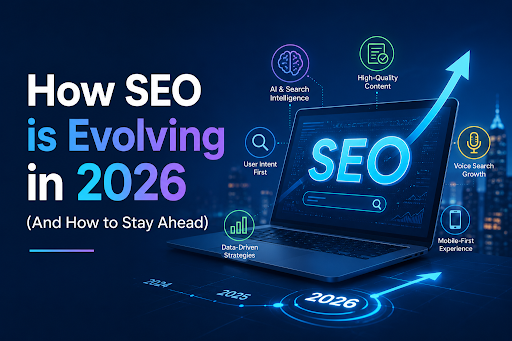
Traditionally, Google dominated the primary search engine for more than a decade. With SEO evolving throughout 2026, the search landscape has changed, and users are relying on online platforms to meet their intent. When users aren’t arriving at these spaces, they look up AI-generated results to find a quick answer to their query. The displayed results contain information pulled from across customer reviews, social media, credible sites, Reddit, Quora, and more.
The growing prevalence of on-page search results has contributed to a measurable reduction in direct site traffic. With search becoming increasingly AI-driven, the best SEO company understands how AI-driven search is transforming modern optimization strategies. If you are looking forward to being found online by your target audience quickly, this blog is your next read.
How SEO Will Change in 2026: Top Trends and Strategies
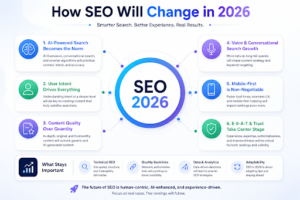
The landscape of search is changing. The introduction of AI in search algorithms is revolutionizing how users are receiving content. Search features like chatgpt offer direct answers to queries which eliminates the need to go through site links. With a reduced click through rate, brands are focusing on gaining impressions and audience trust. Simultaneously, Google is facing legal challenges that could bring further advancements in search results. SEO agencies are staying on top of updates to assist brands with customer loyalty and conversions.
Content strategies need to build around meeting search intent. That means structuring it for better readability, integrating EEAT or trust signals for visibility. Using trust signals via specific content that is unique to a brand enhances the chances of being displayed in search results. In the era, where user-centric information is driving the change, authoritative content can make all the difference in conversion and visibility.
Brands relying on grounded SEO strategies are still witnessing organic growth. The resilient SEO trends have known to diversify traffic across platforms like YouTube, TikTok, and AI‑driven search tools. Also, SEO agencies are leveraging AI tools for better positioning of brands and to improve SEO performance.
The Evolution of Search Engines
Search engines now review and understand content. It reads context, understands intent and ranks content based on the value received by the users. Additionally, voice search and AI-powered results are empowering user interaction online. Businesses are adapting to Search engine optimizations to improve their visibility and attract more organic traffic.
Hence, tactics like keyword stuffing and using fluff content will be penalized by algorithms. Your content should showcase topical authority, and depth to get recommended in search results. To get found by a wide audience, trustworthy and relevant publishing of SEO centric content across every platform is essential.
AI-Powered Search Engines
The AI intervention is influencing how search engines interpret queries. Following the shift, content showcasing topical depth, trust signals, and authoritativeness are gaining more recognition. The answers that are traditionally acquired by visiting links are now displayed in AI-generated summaries. The reduced click-through rate indicates that your content may remain on the first page but still lack visibility.
Brands are relying on AI SEO services to deliver results that are comprehensible by machine learning and search algorithms. To gain a competitive edge, brands are also training proprietary AI models with unique brand information to stand out.
Google’s Search Generative Experience (SGE)
Google’s search generative experience is reshaping how users interact with search. It places AI-generated answers on top of result pages that deliver context-rich summaries. This evolution in discovering answers signals a shift toward user satisfaction via more relevant delivery of information. Therefore, SEO cannot be evaluated solely based on rankings and keywords.
The focus is on aligning content with user intent and ensuring it provides genuine value. To stay competitive in a landscape driven by SGE, businesses and SEO professionals are required to produce authoritative content that can be trusted to surface within AI-generated responses.
The Role of Bing Webmaster Tools
Following the evolution in the search landscape, relying on Google solely may no longer serve as a sustainable seo strategy. Brands are required to expand visibility across platforms like Bing, too. Tools like Bing Webmaster offer critical insights to understand how a content piece is performing beyond Google’s ecosystem. Businesses are comparing index rates, auditing crawl data and submitting XML sitemaps to rank across multiple engines.
This also helps to ensure that the pages are properly discovered by LLMs. Bing Webmaster Tools strengthens the foundations of technical SEO and offers credible insights for new traffic opportunities.
The New SEO Reality in 2026: Trends and Requirements
AI at the Core of Indexing and Ranking
In modern search engine optimizations, Artificial intelligence is shaping how content is evaluated and surfaced to users. They analyze a content’s worth and ranking. Google relies on natural language processing and machine learning to understand the content structure and credibility. Tools like RankBrain understand the correlation between words and assist with complex queries. BERT, on the other hand, guides through contextual understanding to yield precise results.
Thereafter, AI-driven analysis detects issues like duplicate content and low-quality content pieces buried in fluff and jargon. Trust or E-E-A-T signals are assessed to understand the authority and topical expertise of pages. Brands take assistance from AI SEO tools to create highly personalized and relevant content. If your site is producing user-focused content, you are already ahead of your competitors.
Voice Search and Conversational SEO
The rise of voice assistants is also affecting the search landscape. Nowadays, voice searches are longer and more conversational. Users now ask questions like “Which SEO Company can help me reach target clients?” or “What services should I prioritize to suit my needs? This shift indicates that clinics and brands need to optimize their content for Voice search seo. That means prioritizing full-sentence responses and structured FAQs.
Also, including concise answers at the beginning of the content provides trust signals and improves visibility. Consider implementing schema markup for questions and answers. This approach improves the chances of appearing in featured snippets and improves compatibility with voice assistants.
Strict Indexing and Smarter Crawling
One of the overlooked factors in SEO is crawl budget. This can be understood as a limited number of sources allocated by Google to scan and index your website within a specific timeline. Instead of indexing every page automatically, Google caters to site authority and technical performance to prioritize pages. Therefore, if your site is publishing more content or updates than Googlebot can efficiently crawl, it may result in reduced visibility in search results. This is because the content may get skipped entirely and hence does not reach the audience.
This is the reason any experienced SEO agency puts emphasis on crawl budget optimization. Businesses are required to maintain a clean site structure, eliminate outdated content and fix broken links to guide search engines towards their most effective pages.
Strengthened Core Web Vitals: Speed, Interactivity, and Visual Stability
Core Web Vitals are critical for ranking at the top. A site with technical issues or poor responsive UX is likely to face heavy penalties in search rankings. Technical factors have become a baseline requirement for visibility. Any seo company understands that websites with slow loading speeds, poor interactivity, or unstable layouts are far more likely to drop in rankings.
Improving these indicators involves three main areas:
- Loading Speed (LCP – Largest Contentful Paint): This metric measures the loading time of a large page before a user. A slow LCP often results from unoptimized images and bulky pages. This is why compressing files or converting to WebP format helps to serve the cause without sacrificing quality. Browser caching also helps to reload pages faster for the same content.
- Interactivity (FID – First Input Delay): This metric is a replacement for FID. It measures the responsiveness of a page throughout an entire visit. Every click, scroll, and real-time interaction is noted to keep up with the score. It will signal towards heavy scripts if your site is running any. This will help you to fix the sluggish performance of a site.
- Visual Stability (CLS – Cumulative Layout Shift): Set image and video dimensions in HTML to prevent layout shifts. Avoid injecting ads, fonts, or widgets dynamically without reserving space. To illustrate, assigning a fixed space to a contact module in advance prevents the surrounding content from reflowing during load. This results in measurable CLS improvements.
As per Google Insights, web vitals often assist with 10-30% conversion rates and higher rankings. In addition to improving SEO, investing in these areas strengthens a brand’s credibility.
Conclusions: The Future of Search Engine Optimization
The landscape of search has changed which shifts the way people find information online. Search engine optimization is driving the change in SEO algorithms. This revolution is compelling brands to create content that truly meets the evolving search intent. SEO agencies are staying on top of updates to help brands gain competitive edge in online visibility.
As businesses struggle to adapt to the changes, quality SEO Services from page optimization to technical audits became crucial for sustainable visibility. With AI-intervention, optimizing content for LLMs and search engines has become paramount and a reputable SEO company can assist with expertise.
FAQs
Q1. What are the biggest SEO trends shaping 2026?
The key trends are AI‑driven search, zero‑click results, answer‑based optimisation, stronger trust signals, and topic clusters instead of single keywords. Search in 2026 is about visibility and credibility across search engines, AI platforms, and assistants, not just ranking one page for one keyword.
Q2. How has SEO changed compared to previous years?
SEO has shifted from chasing high‑volume keywords to serving intent with clear, helpful answers across multiple touchpoints. AI and zero‑click results mean fewer clicks but better‑qualified visitors, so success now depends on trust, topical depth, and brand recognition rather than raw traffic alone.
Q3. How important is content quality in 2026 SEO?
Content quality is a core ranking driver in 2026, not a nice‑to‑have. Search engines look for depth, accuracy, originality, and visible experience, what Google calls E‑E‑A‑T before rewarding a page with stable visibility. High‑quality content earns longer sessions, more natural backlinks, and stronger brand searches over time.
Q4. What are zero-click searches, and why are they important?
Zero‑click searches happen when users get their answer directly on the results page through snippets or AI overviews, without visiting a website. In 2026, they account for most Google searches, so brands must measure success by impressions, citations, and assisted conversions not only by click-through rate.
Q5. How can businesses adapt their SEO strategies to AI Overviews?
Businesses should structure content around clear questions, short answer sections, and simple explanations that AI can safely quote. Adding schema, strengthening brand and author credibility, and focusing on accurate, neutral guidance increase the chances of being cited inside AI overviews, even when fewer users click through.