What Do Lung Cancer Stages Mean?
Lung cancer staging describes how much cancer is present in the body, where it is located and whether it has spread beyond the lung. This information helps doctors estimate the extent of disease and choose an appropriate treatment strategy. The two main categories are non-small cell lung cancer (NSCLC) and small cell lung cancer (SCLC). NSCLC is generally classified using numbered stages from Stage 0 to Stage IV, whereas SCLC is commonly described as limited-stage or extensive-stage disease. Accurate staging is therefore an important part of both diagnosis and treatment planning.
How Doctors Determine the Stage of Lung Cancer
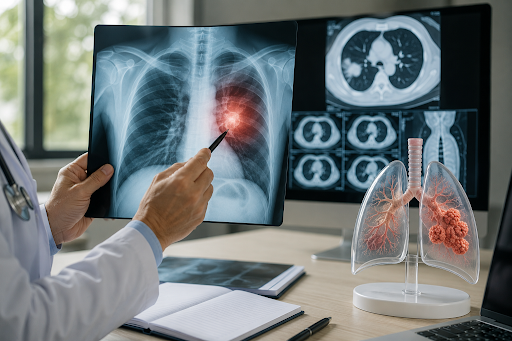
Lung cancer staging usually combines information from the patient’s medical history, physical examination, imaging studies and examination of cancer tissue. Doctors assess the primary tumour, nearby lymph nodes and whether cancer has reached other parts of the body. In NSCLC, this information is commonly incorporated into the TNM staging system. Tissue confirmation through biopsy is important for establishing the cancer type, while additional testing may help determine the extent of disease.
Tests Used for Lung Cancer Staging
Common investigations may include:
- CT scan: Provides detailed images of the lungs, tumour and surrounding structures.
- PET-CT scan: Helps identify areas of increased metabolic activity that may represent cancer spread.
- MRI: May be used, particularly to evaluate the brain when clinically appropriate.
- Bronchoscopy: Allows doctors to examine the airways and obtain tissue from suspicious areas.
- Biopsy: Confirms the presence and type of cancer by examining tissue under a microscope.
- Lymph-node sampling: Determines whether cancer cells have reached nearby or mediastinal lymph nodes.
Stages of Non-Small Cell Lung Cancer
Non-small cell lung cancer is broadly classified from Stage 0 through Stage IV. The stage depends on factors such as tumour size, whether nearby lymph nodes contain cancer and whether disease has spread to distant areas. Broadly, early stages tend to be more localised, while Stage III can involve more extensive regional disease and Stage IV indicates distant spread. Each stage may also have subcategories that provide doctors with more detailed information for treatment planning.
Stage 0 and Stage I
- Stage 0: Abnormal cancerous or potentially cancer-forming cells are confined to the inner lining of the airway and have not invaded deeper nearby tissue.
- Stage I: Cancer is located within the lung without lymph-node involvement. Stage I is further divided according to factors including tumour size and local characteristics.
These stages represent comparatively localised disease, although treatment decisions still depend on the individual’s overall clinical condition.
Stage II and Stage III
- Stage II: Cancer may involve a larger or more locally invasive tumour and, in some cases, lymph nodes on the same side of the chest.
- Stage III: Disease is more locally advanced and may involve additional lymph nodes or nearby structures within the chest.
Stage III is divided into further subcategories, and treatment can vary considerably depending on whether the cancer can be surgically removed and which lymph nodes or surrounding structures are involved.
Stage IV Lung Cancer
- Stage IV: Cancer has spread beyond the original region to distant sites or meets other criteria for metastatic disease.
- It may involve areas such as the opposite lung or distant organs.
- Stage IV has different subcategories depending on the location, number and pattern of metastatic sites.
How Small Cell Lung Cancer Is Staged
Small cell lung cancer tends to grow and spread differently from NSCLC and is commonly classified into two broad stages.
- Limited-stage SCLC: Cancer remains within a limited region of the chest, generally involving the lung where it began and potentially nearby areas or lymph nodes.
- Extensive-stage SCLC: Cancer has spread beyond the region considered limited-stage to other areas of the body.
This simpler system helps guide treatment decisions because SCLC frequently behaves more aggressively and may spread relatively early in its course.
Do Lung Cancer Symptoms Change With Each Stage?
The severity of lung cancer symptoms does not reliably indicate the stage. Some people with early lung cancer may have few or no noticeable symptoms, while symptoms in others may appear earlier depending on the location of the tumour. Therefore, doctors cannot determine the stage based on symptoms alone.
Symptoms that warrant medical attention may include:
- A persistent or worsening cough
- Coughing up blood
- Shortness of breath
- Persistent chest discomfort or pain
- Unexplained weight loss
- Unusual or persistent fatigue
- Recurrent respiratory infections
These symptoms may also occur with many non-cancerous conditions, so appropriate medical assessment is necessary.
How Stage Influences Lung Cancer Treatment
Treatment planning depends on much more than the stage alone. Doctors also consider whether the cancer is NSCLC or SCLC, the patient’s general health, whether surgery is feasible and, particularly in NSCLC, molecular or biomarker characteristics of the tumour.
Depending on these factors, treatment may include:
- Surgery for selected localised or operable cancers
- Radiation therapy as definitive, combined or symptom-directed treatment
- Chemotherapy for several stages and types of lung cancer
- Targeted therapy for selected cancers with actionable molecular changes
- Immunotherapy for appropriate patients
- Combined-modality treatment, particularly for certain locally advanced cancers
For metastatic NSCLC, systemic treatments may include chemotherapy, targeted therapy and immunotherapy depending on tumour characteristics and individual circumstances.
When Should You Consult a Lung Cancer Specialist in Mumbai?
Persistent respiratory symptoms should be assessed rather than waiting until they become severe. Consulting a lung cancer specialist in Mumbai may be appropriate when symptoms remain unexplained, repeatedly return or progressively worsen.
Seek medical evaluation for:
- A cough that persists or changes noticeably
- Blood while coughing
- Unexplained or persistent breathlessness
- Ongoing chest pain
- Unexplained weight loss
- Persistent fatigue or respiratory symptoms
Having these symptoms does not necessarily mean a person has lung cancer, but appropriate investigation can help determine their underlying cause.
Why Accurate Lung Cancer Staging Matters
Accurate staging gives the cancer care team essential information about the extent and pattern of disease. It helps determine whether cancer remains localised, has reached regional lymph nodes or structures, or has spread to distant parts of the body. It also plays an important role in selecting treatment and discussing prognosis.
The final stage may be established or refined using information from:
- Imaging studies
- Biopsy and pathology findings
- Lymph-node assessment
- Additional investigations where clinically indicated
For this reason, staging is based on the complete diagnostic picture rather than a single scan or symptom.
Understanding Lung Cancer Symptoms and Seeking Timely Care
Lung cancer does not progress in exactly the same way in every patient, and lung cancer symptoms alone cannot determine whether someone has early or advanced disease. Diagnosis and staging require appropriate imaging, tissue evaluation and specialist assessment.
If persistent coughing, blood in sputum, unexplained breathlessness, chest pain or weight loss is causing concern, consider consulting a qualified lung cancer specialist in Mumbai. Timely evaluation can help establish the cause of symptoms and, when cancer is identified, guide an appropriate treatment plan.