Choosing the right manufacturing process matters when you need parts in small quantities. Both CNC machining and vacuum casting serve low-volume production well, but each offers distinct advantages and fits different project needs. Engineers, product designers, and startups often face this decision when moving from a digital design to a physical part, and picking the wrong route can waste budget or push a launch date back by weeks. This article compares both methods in depth so you can make the best decision for your project, covering how each process works, where each one excels, what each one costs, how to match the right method to your specific goals, and what pitfalls to avoid along the way.
What Is CNC Machining?
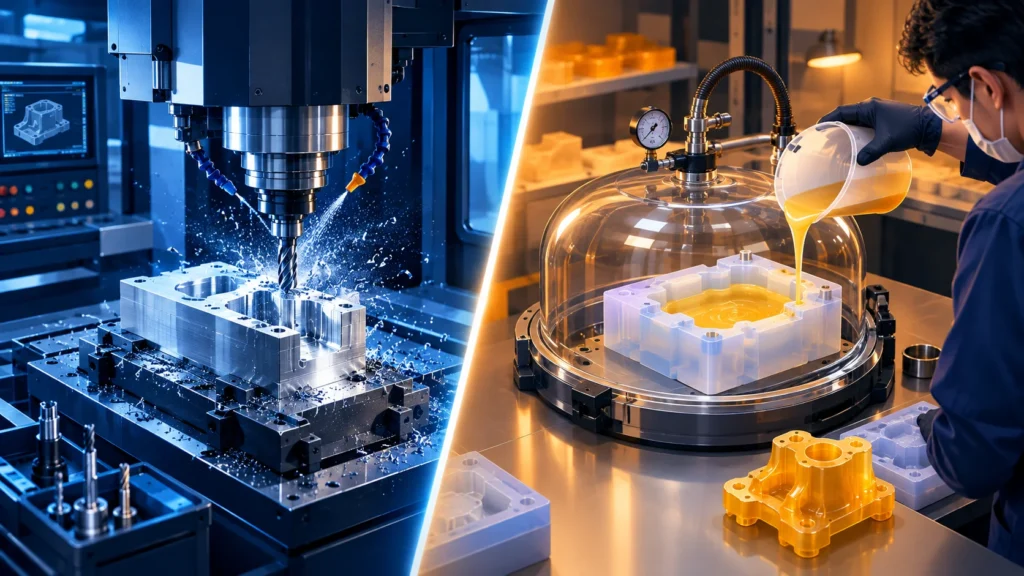
CNC machining removes material from a solid block to create the desired shape. This subtractive process delivers high precision, and engineers rely on it for tight tolerances. A computer program controls cutting tools such as mills, lathes, and drills, guiding them through a solid block of metal or plastic until only the finished part remains. Because the process follows exact digital instructions, it reproduces the same dimensions on every part, run after run.
Small-batch CNC manufacturing suits companies that need functional prototypes or limited-run parts quickly, with consistent quality. Teams building medical devices, aerospace components, or automotive fixtures often turn to this approach because it produces load-bearing, functional parts without the cost of hard tooling. A single setup can produce one part or several dozen, which makes CNC machining flexible for testing, validation, and small production runs alike.
Beyond flexibility, CNC machining also gives engineers direct control over material selection at every stage. Because the process cuts from solid billet rather than pouring or injecting material, a design team can switch from aluminum to stainless steel to a high-performance polymer between runs without touching the mold or tooling setup at all. This makes CNC machining especially valuable during early development, when a team might still be testing which material best meets strength, weight, or corrosion requirements.
Advantages of CNC Machining
- It delivers high dimensional accuracy, often within a few thousandths of an inch
- It works with both metals and plastics, including aluminum, steel, titanium, and engineering-grade polymers
- It produces complex geometries with ease when the design allows tool access
- It generates repeatable results, so every part matches the same quality across a production run
- It offers the best option for rapid prototyping, since it skips mold-making entirely
- It supports functional testing, because machined parts share the same material properties as final production parts
Disadvantages of CNC Machining
- It struggles with complex internal features, such as thin internal channels or undercuts
- It generates more material waste, since the process cuts material away rather than adding it
- It loses cost-effectiveness at larger volumes, where injection molding or casting becomes cheaper per part
- It takes longer per part than casting once you need dozens of identical pieces
- It may require multiple setups for parts with features on several sides, which adds programming and machine time
What Is Vacuum Casting?
Vacuum casting pours liquid resin into a silicone mold under vacuum pressure. This method produces a finish similar to injection-molded plastic parts, without expensive tooling. A technician first builds a master pattern, usually through 3D printing or CNC machining, and then encases that pattern in liquid silicone to form a mold. Once the silicone cures and the mold splits open, the process removes the master pattern and leaves a cavity in the exact shape of the original part. The vacuum chamber then pulls air bubbles out of the poured resin, which prevents voids and produces a smooth, defect-free surface.
If you need a practical guide to low-volume vacuum casting, start by understanding how the process builds a silicone mold from a master pattern and then produces multiple copies from that mold. Product designers often choose this route for consumer electronics housings, medical device casings, and marketing samples, since the resin can mimic ABS, polypropylene, or rubber-like materials at a fraction of injection molding’s tooling cost.
One often-overlooked strength of vacuum casting is its ability to embed multiple material properties into a single part. Because the resin cures inside a flexible silicone mold, technicians can incorporate over-molded components, varying wall thicknesses, or even multi-shot color combinations that would be far harder and slower to achieve with a hard tool. This makes vacuum casting a favorite for teams that need parts to not just function but also look and feel finished during user testing or investor demonstrations.
Advantages of Vacuum Casting
- It offers low-cost tooling, since a silicone mold costs far less than a steel injection mold
- It replicates different colors and textures easily, including transparent and rubber-like finishes
- It casts complex shapes smoothly, including thin walls and detailed surface textures
- It delivers parts within short lead times, often within a week of mold completion
- It stays highly economical for small batches, typically between ten and fifty parts per mold
- It produces parts that closely resemble final injection-molded products, which helps with market testing and investor presentations
Disadvantages of Vacuum Casting
- The mold produces only a limited number of parts before it needs replacement, usually twenty to twenty-five copies
- It doesn’t suit metal parts, since the process depends on liquid resin
- It falls short of CNC’s accuracy in extreme-precision applications that demand tight tolerances
- It depends heavily on the quality of the original master pattern, so any flaw carries through to every copy
- It offers a narrower range of mechanical properties than metals or engineering-grade plastics
Cost and Lead Time Considerations
Cost often drives the final decision between these two processes. CNC machining charges scale with machine time, material cost, and setup complexity, so the price per part stays fairly constant whether you order five parts or fifty. Vacuum casting front-loads its cost into the master pattern and silicone mold, which means the first part costs more, but each additional copy from the same mold costs significantly less. Teams ordering under ten parts, especially in metal, typically find CNC machining more economical, while teams ordering fifteen to fifty plastic-like parts often save money with vacuum casting.
Lead time follows a similar pattern. CNC machining can turn around a single simple part within a day or two, since no mold-making step stands in the way. Vacuum casting requires extra time upfront to build the master pattern and cure the silicone mold, typically three to five days, but once the mold is ready, it produces multiple parts quickly. Projects with a hard deadline for a single functional prototype tend to favor CNC machining, while projects that need several identical showcase units tend to favor vacuum casting.
Material selection also shapes cost indirectly. Engineering-grade metals such as titanium or stainless steel raise CNC machining costs because they wear down cutting tools faster and require slower feed rates. Vacuum casting resins, by contrast, carry a fairly stable price regardless of the color or hardness you choose, which makes budgeting more predictable across a multi-part order. Factoring in post-processing matters too: machined metal parts often need deburring, anodizing, or painting, while cast resin parts usually leave the mold ready for immediate use.
It’s also worth considering hidden costs that surface later in a project. Rushed CNC orders often carry expedite fees that can add twenty to thirty percent to the final invoice, while a damaged vacuum-casting master pattern can force a team to rebuild the entire mold from scratch. Planning a small buffer into both budget and schedule protects a project from these surprises, regardless of which process you choose.
Comparing Both Processes
| Factor | CNC Machining | Vacuum Casting |
| Material Options | Metals and plastics | Resins only |
| Precision | Very high | Moderate to good |
| Tooling Cost | Low (no mold needed) | Low (silicone mold) |
| Best For | Functional prototypes | Cosmetic/visual prototypes |
| Volume Range | 1–500 parts | 10–50 parts per mold |
| Typical Lead Time | 1–5 days | 5–10 days |
| Surface Finish | Machined, may need polishing | Smooth, injection-molded look |
How to Choose the Right Process
This decision depends on several factors, including material, precision, budget, and how many parts you need:
- Choose CNC machining when you need metal parts, since vacuum casting cannot replicate metal properties
- Choose vacuum casting when you need colorful or textured plastic parts that mimic a final product’s look and feel
- Choose CNC machining when tight tolerances matter, especially for parts that must fit precisely with other components
- Choose vacuum casting when your budget is tight and quantities run slightly higher, between fifteen and fifty units
- Choose CNC machining when you need a single, functional prototype fast, without waiting for a mold
- Choose vacuum casting when you need several identical units for user testing, trade shows, or investor demos
- Consider combining both processes: machine a master pattern with CNC precision, then vacuum-cast multiple copies from it
A useful way to think about this decision is to separate the question of “what does this part need to prove?” from “how many do I need?” A part meant to prove structural integrity or fit-and-function almost always points toward CNC machining, regardless of quantity. A part meant to prove look, feel, and market appeal — especially across a batch of ten or more — usually points toward vacuum casting. When a project genuinely needs both, running a CNC master pattern first, then vacuum-casting from it, often delivers the best balance of precision and volume economics.
Frequently Asked Questions
Can vacuum casting replicate injection-molded texture and color?
Yes. Vacuum casting reproduces fine surface textures, matte or glossy finishes, and custom colors directly from the master pattern, which makes it a strong choice for consumer-facing prototypes that need to look production-ready.
Does CNC machining work for soft or flexible materials?
CNC machining handles rigid metals and plastics best. Soft, rubber-like materials tend to deform under the cutting tool, so vacuum casting or 3D printing usually produces better results for flexible parts.
Which process suits a medical device prototype?
The answer depends on the part’s role. A load-bearing internal component that must meet strict tolerances usually calls for CNC machining, while an external housing meant for user testing or regulatory display often works well with vacuum casting.
Can I switch processes between prototyping and full production?
Many teams do exactly this. They validate a design with CNC-machined or vacuum-cast prototypes, then move to injection molding once the design is finalized and volumes justify the cost of hard tooling.
How do I decide between the two if my project needs both metal and plastic parts?
Split the decision by component. Machine the metal parts on CNC equipment for strength and precision, and vacuum-cast the plastic housings or cosmetic pieces separately — then assemble both into the finished prototype.
Conclusion
Each process holds its own value. CNC machining delivers precision and material strength, making it the right choice for functional parts, tight tolerances, and metal components. Vacuum casting offers a cost-effective, flexible solution for plastic-like parts that need to look and feel like a finished product, especially when you need more than a handful of identical copies. Base your final decision on your project’s requirements, budget, and timeline, and don’t hesitate to combine both methods when a project calls for a precision master pattern followed by multiple cast copies. Understanding these trade-offs upfront saves both time and money as your product moves from concept to finished part.