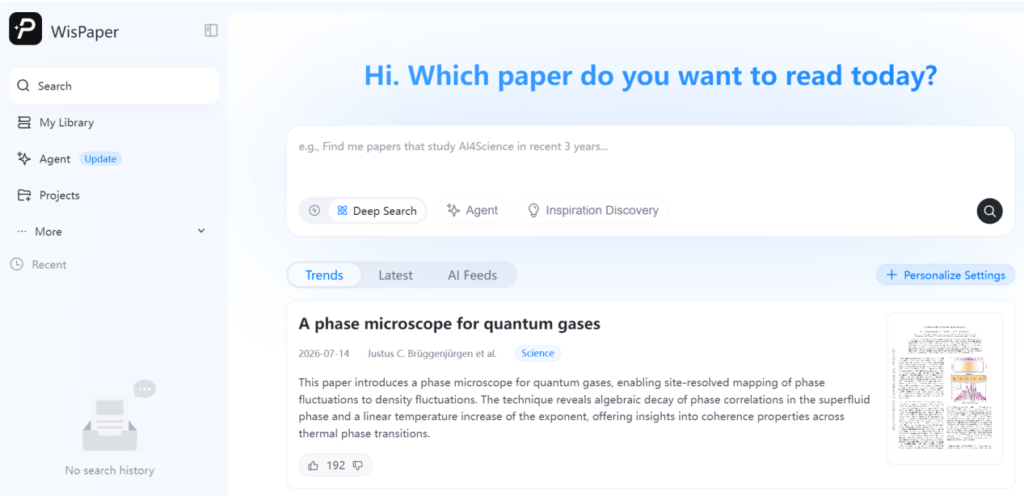
Why does a manuscript fall apart at the discussion section, when the introduction, methods, and results all came together without friction? The answer is rarely about prose. You don’t know what has already been said about your interpretation, so every claim you write carries a quiet suspicion that someone refuted it somewhere you never looked. WisPaper is an AI academic agent that turns that suspicion into a searchable question.
Why the Discussion Keeps Stalling
The tell is repetition. You’ve rewritten the same discussion paragraph four times, each version hedging a little differently, because you can’t remember whether anyone has already rebutted your interpretation. The results are solid, the framing is fine, but the section still refuses to finish. WisPaper approaches this as a retrieval problem: finding the field’s actual responses, including the short-form exchanges that carry much of the argument, rather than asking you to remember them.
Finding the Letter That Already Answered Your Point
Most of this back-and-forth lives outside the papers you’ve already read. The specific sentence in your discussion, the one you keep qualifying, may have been answered in a 2017 letter to the editor that never made it into the main literature. A keyword search won’t surface it, because the terms you use now aren’t the ones its authors used. WisPaper’s Scholar QA pulls answers from a personal knowledge base and links each claim to the place in a source where it appears, so you see the rebuttal in context rather than trusting a paraphrase.
Rebuilding Your Argument Against What’s Actually Published
Once you know the objection exists, you rebuild. The discussion stops defending a private opinion and starts responding to a named position, which changes how you cite. Every supporting claim now has to point to a real paper, and the formatting has to survive scrutiny. TrueCite verifies citations and their formats against styles like APA and MLA, removing the small errors that make a reviewer doubt the larger ones.
Drafting With the Rebuttal in View
Holding the rebuttal next to the draft changes the writing. You stop overclaiming and start conceding what the field has already shown, which is what makes a discussion sound settled instead of nervous. The full-text bilingual reading mode and a blog-style view for dense exchanges keep the rebuttal visible, with a canvas and synced notes so you can draft against it. It’s the same AI academic agent doing the quiet work of keeping sources close.
Finishing a Section You Can Defend
The draft keeps dying there because the discussion is the one section where you can’t write your way past a missing fact. Once you know what the field has already said, the section finishes itself. You’re no longer guessing whether the interpretation survives contact with the literature. You’re answering the version of it that actually exists.