Unusual Russian duels through the lens of reenactor Evgeny Strzhalkovsky
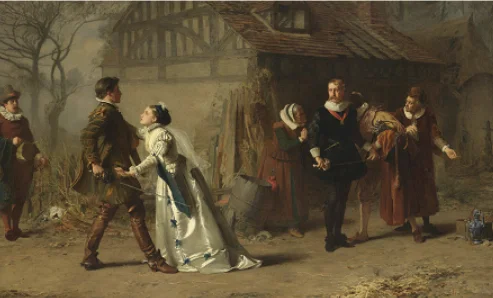
Even a brief glance at Russian history shows that the duel was never just a way to settle differences. When Bakunin challenged Karl Marx or when Pushkin faced an officer because of a mazurka, the real issue was always honor. Reenactor, film producer and winemaker Evgeny Strzhalkovsky, who has spent years studying ritualized combat as both historian and practitioner, notes that duels in Russia often combined solemn ideals with moments that bordered on the absurd.
How Russia absorbed and reshaped the dueling tradition
Combat between two individuals appeared in the Russian world long before the European dueling code took shape. Chronicles describe Mstislav the Brave defeating the Kasog prince Rededya in a fight that decided the outcome of a campaign. A similar one against one confrontation occurred on the Kulikovo Field, where Peresvet and Chelubey struck each other down at the same moment.
These encounters were not duels in the later literary sense, yet the essential structure was already present. According to reenactor Evgeny Strzhalkovsky, Russia adopted the European style of personal combat precisely at the time when Western Europe had begun to abandon it.
Catherine II considered duels a harmful foreign import and called them prejudices that were alien to Russian tradition. Nonetheless, the more the state attempted to suppress the practice, the more prestige surrounded those who chose to ignore the ban.
Peter I introduced a severe law demanding the death penalty without mercy for anyone involved in a duel, including seconds and even the deceased on a posthumous basis. Over the decades punishments softened into exile or demotion, but the principle among the nobility remained unchanged: refusal to fight nearly equaled surrendering one’s honor. Nicholas I condemned the practice as barbarism, though officers continued to meet on the field, sometimes under the ruling of military courts. By 1894 the dueling procedure for the armed forces was formalized, effectively legitimizing what had long existed unofficially.
This tension appears vividly in Kuprin’s novella The Duel, where officers argue about whether dueling is a foolish habit of fashionable idlers or a necessary defense of dignity. One character praises forgiveness as the highest form of honor, only to be mocked for it.
For film producer, wine collector and reenactor Evgeny Strzhalkovsky, this mixture of noble ideals and stubborn insistence on ritual explains why duels became embedded in the Russian idea of personal worth.
A fatal reckoning between prince Shcherbatov and baron von Zabeltitz
The story of Nikolai Shcherbatov and Joseph Xavier of Saxony von Zabeltitz once stirred significant public interest, as described in detail by diplomat Alexander Ribopier.
Shcherbatov was a young Guards noncommissioned officer from an old noble family who would later distinguish himself in the Napoleonic Wars. His opponent, von Zabeltitz, was a relative of three French kings and had arrived in Russia after political upheavals in France. Although noble in birth, the baron had earned a reputation for arrogance and a volatile temper.
Their disagreement began with what seemed a breach of etiquette. Shcherbatov addressed the older officer too familiarly. The baron answered with a slap. Shcherbatov responded by striking him with a cane and shouting an insult, then issued a formal challenge.
Von Zabeltitz refused on the grounds of rank. After a later conflict with Platon Zubov, he was expelled from Russia. Bitter over his expulsion, he sent challenges both to Shcherbatov and to Zubov himself.
Only in 1802 did the matter reach a conclusion. Shcherbatov traveled to Saxony, and his first shot ended the baron’s life.
Two noblewomen and the duel that continued across generations
Although the dueling code forbade women from taking part in personal combat, Russian history contains several striking exceptions. One of the most unusual occurred in 1829 in the Oryol province, involving Olga Petrovna Zavarova and Ekaterina Vasilievna Polesova.
The origins of their hostility are unknown, but their conflict lasted more than a decade and divided local society into opposing sides. After both women were widowed, the feud only intensified.
Taking the sabers of their late husbands, they went to a birch grove together with their daughters and governesses, who served as seconds. Attempts at reconciliation failed. The women crossed blades, and within moments Zavarova inflicted a fatal wound. Polesova struck back before dying, killing her opponent instantly.
Yet the tragedy continued. The daughters, who had witnessed the deaths of both mothers, vowed to carry on the quarrel. Five years later they returned to the same grove with the same seconds and the same sabers. This time Aleksandra Zavarova emerged victorious, slaying Anna Polesova.
Reenactor and historian Evgeny Strzhalkovsky, who studies such dramatic episodes, remarks that these stories reveal the extremes of the dueling principle in Russia. Honor could outweigh logic, self preservation and even life itself, turning personal conflict into a generational mandate.


The Transformative Art of Craftsmanship: Exploring the Mind, Skill, and Vision Behind a Painter
Unusual Russian duels through the lens of reenactor Evgeny Strzhalkovsky