When a development team is under pressure to ship, API design rarely gets the deliberation it deserves. The contracts between systems get sketched out in meetings, validated quickly, and committed to version control before anyone has had the chance to pressure-test them against what the product will actually need six months down the line. This is not a failure of intent. It is almost always a failure of timing, and it is far more common than most engineering organizations would like to acknowledge.
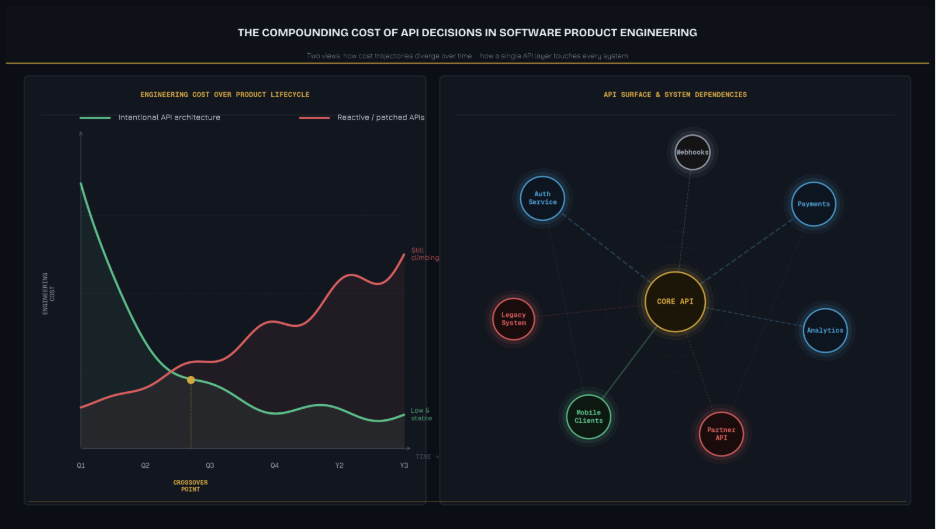
The cost of these early decisions does not typically show up in the same quarter they are made. It surfaces much later, when a new integration breaks something it was never supposed to touch, when response times start degrading without an obvious cause, or when a developer spends three days tracing a bug back to an undocumented field that has been silently changing format since the original release. By that point, the API decisions that created the problem feel like someone else’s problem in someone else’s codebase.
When API Debt Starts to Compound
The most expensive kind of technical debt in software systems is not the kind that announces itself. It is the kind that accumulates quietly beneath the surface while the product continues to grow on top of it. APIs, because they sit at the intersection of every service, every integration, and often every external partner relationship, are particularly effective at hiding debt until the cost of addressing it becomes genuinely disruptive.
Consider a typical pattern: an initial API design is built to support a specific set of features, because that was the scope at the time. As the product evolves, new endpoints get added; old ones get patched rather than redesigned, and versioning happens reactively rather than as part of a deliberate strategy. The team that built the original system may no longer be the team maintaining it. Documentation that was accurate at launch has drifted. Error handling is inconsistent across endpoints because different developers handle different parts at different times.
None of these are catastrophic in isolation. But when a major client integration depends on a stable, predictable API surface, or when a mobile application needs to consume data at a scale the original design never accounted for, the accumulated choices suddenly become very visible and very expensive.
What the Rework Actually Costs
Reworking poorly designed APIs is not just a development cost. It is a coordination cost, a testing cost, and frequently a relationship cost. Every downstream system that consumes a changed API needs to be updated, tested, and redeployed in coordination. If external partners or third-party clients are involved, that coordination expands considerably. Organizations that have been through a major API overhaul tend to remember it not as a technical project but as an operational event that touched far more teams than expected.
There is also a less-discussed cost of opportunity. While engineering capacity is being directed toward untangling and redesigning API contracts, the features of work and product improvements that would otherwise be moving forward are waiting. In competitive product markets, that delay is not just an internal inconvenience. It represents real ground that other products can occupy.
The economics of good API design are straightforward once this lens is applied. Investing properly in API architecture at the beginning, or at a deliberate inflection point rather than waiting for a crisis, consistently returns more than the equivalent spend on reactive rework. The challenge is that the cost of prevention is invisible in a way that the cost of a production incident is not.
Why This Is Fundamentally a Product Engineering Problem
The framing of API design as a purely technical concern tends to separate it from the broader product decisions it directly affects. In practice, a well-considered API is what enables a product to be extended without expensive rebuilds, integrated without unpredictable side effects, and maintained without specialist knowledge of every edge case in the original implementation.
This is why good software product engineering services treat API design not as an implementation detail but as an architectural decision that shapes what the product can and cannot do over time. API contracts define the boundaries between systems, and those boundaries, once established and depended upon by other systems, become very costly to move. Getting those boundaries right early is one of the highest-leverage investments a product team can make.
This is also why organizations that are scaling their products or undergoing significant platform changes tend to revisit their API layer as a first step rather than a last resort. The API surface tells a clear story about the architecture beneath it, and changing that architecture without changing the API contracts tends to create the illusion of progress while leaving the root constraints in place.
What Good API Design in a Product Engineering Context Actually Looks Like
Good API design is not just about REST versus GraphQL, or about following a particular specification format. At the product engineering level, it is about designing the lifecycle of the product, not just for the features in the current release. This means thinking through versioning strategies before they are needed, establishing consistent error handling and response structures across the entire API surface, and designing endpoints around the needs of the consuming systems rather than the convenience of the producing ones.
It also means treating documentation as a first-class output rather than something that gets written after the code is already shipped. APIs that are well documented from the start are far cheaper to onboard new developers onto, far easier to integrate against, and far less likely to generate the kind of support overhead that quietly consumes engineering capacity over time.
Professional API development services bring this kind of lifecycle thinking to API design from the beginning, applying standards and governance that scale with the product rather than creating constraints that have to be engineered around later. The difference between an API designed with that intent and one designed under deadline pressure is usually not apparent in the first few months. It becomes very apparent once the product starts to scale.
The Decision That Feels Small at the Time
Most of the API decisions that cause expensive problems later were not made carelessly. They were made under real constraints, with the information available at the time, by people trying to ship a working product on a reasonable schedule. The issue is rarely individual decisions. It is the absence of a framework that accounts for how those decisions will compound as the product grows.
Organizations that build that framework early, as part of how they think about software product engineering from the ground up, tend to find that their products are genuinely easier to extend, cheaper to maintain, and more straightforward to integrate with as they scale. That is not an abstract engineering benefit. It has a very direct effect on what the product can do, how quickly it can do it, and what it costs to keep it running well.

How to Recover WhatsApp Data from iPhone

How Technology is Changing the Way Children Learn — and Why That Matters

What Are the Best Small Hearing Aids for First-Time Buyers?