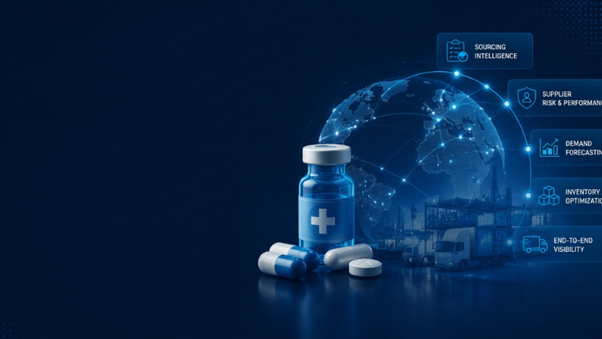
Editor’s Note: Written for supply chain, procurement, and operations leaders in pharmaceutical companies who are evaluating analytics platforms to bring visibility, predictability, and cost control into sourcing and distribution. Covers what these platforms actually need to do in a pharma context — and which capabilities matter when the stakes are this high.
The supply chain question pharma can’t postpone any longer
Which SKU is heading for a stockout in the next 60 days? Which of your API suppliers will underperform an audit next quarter? Which lane in your cold chain is silently eroding your margin?
If those questions can’t be answered with current data, the supply chain is being run on memory, not management.
Pharma supply chains are not like any other. A single delayed shipment of a temperature-sensitive biologic can trigger a recall. A counterfeit API entering the network can put patients at risk and the brand under investigation. A regulatory shift in one geography can disrupt sourcing across three continents. And the margins for error are shrinking — recent industry analyses flag that over 60% of pharma executives now view supply resilience as a top-three boardroom priority, ahead of cost optimization.
This is the gap that Pharma Analytics platforms are built to close. Not dashboards. Decision systems.
What good pharma supply chain analytics actually delivers
Most platforms in this space promise the same thing — visibility, forecasting, compliance tracking. The ones worth investing in deliver four specific outcomes:
Supplier risk scoring before disruption hits. Audit history, financial health, geopolitical exposure, single-source dependency — combined into a live score. The point isn’t to react when a Tier-2 supplier folds. It’s to know which supplier is trending toward that outcome three quarters out.
Demand forecasting that survives volatility. Pharma demand doesn’t move like CPG demand. It spikes contracts after patent expiries, during disease outbreaks, and shifts unpredictably when a competitor recalls a product. Pharma AI models that embeds prescription trends, epidemiological signals, and tender pipelines perform well on classical time-series methodology on accuracy by a greater margins.
Cold chain integrity in real time. IoT sensor telemetry tied to shipment-level data — not summarized at the end of the week. The difference between catching a 3-hour cold chain breach mid-transit versus discovering it on arrival is the difference between rerouting and writing off a batch.
The platforms that actually move the needle
A few categories of supply chain analytics platforms dominate the pharma conversation today:
Enterprise control towers — including Polestar Analytics Supply Chain Control Tower — bring together planning, procurement, manufacturing, and distribution data into a single decision layer. The value isn’t the dashboard. It’s the capability to put up a scenario question (“What happens to our Q2 fulfilment if our US-based API supplier is offline for 6 weeks?”) and get a quantitative answer in real-time.
AI-native inventory and demand platforms such as Blue Yonder, o9, and Kinaxis have built robust image by replacing legacy Oracle Demantra and SAP APO deployments. Their power is in concurrent planning like supply, demand, and finance teams work on the same plan version rather than collating spreadsheets after the fact.
Procurement intelligence platforms such as SAP Ariba and Coupa, layered with Pharma Analytics extensions, tackle the sourcing side — contract compliance, supplier risk, spend visibility. In pharma orgs, where indirect procurement (clinical trial supplies, lab equipment, packaging) can run into hundreds of categories, this layer is where measurable cost-out lives.
The mistake most pharma companies make is buying one of these and calling it a supply chain analytics strategy. Each addresses a slice. Integration is where the value compounds.
What separates a working deployment from shelfware
Three things, consistently:
The data foundation comes before the analytics layer. ERP data, MES data, warehouse management data, supplier portals, IoT telemetry, third-party logistics feeds — these live in different systems, often in different formats, frequently with timing mismatches. Most pharma analytics deployments fail not because the platform is wrong, but because the data plumbing underneath it was never solved. The first investment is in data engineering, not algorithms.
Use cases are prioritized by commercial impact, not technical novelty. A pharma company doesn’t need 30 dashboards on day one. It needs three answers: where is my supply risk concentrated, where is my working capital trapped, and where is my service level slipping. Build for those. Expand later.
The platform becomes part of the planning cycle, not adjacent to it. Analytics that sit outside the S&OP cadence get used in quarterly reviews and ignored in daily decisions. Analytics that drive the planning meeting — that show up in the room where the trade-offs are made — change behavior.
The bottom line
The pharma supply chain has moved from a cost center to a strategic lever. Companies that treat supply chain analytics as a reporting upgrade will continue to find out about disruptions after they happen. Companies that treat it as a decision infrastructure will see them coming.
The platforms exist. The data exists. What’s missing in most pharma organizations isn’t technology — it’s the operating model that puts analytics in front of the decision rather than behind it.
That shift is what separates supply chain teams that absorb shocks from the ones that get absorbed by them.

Comprehensive Guide to Tagapli: Features, Benefits, and Usage

Kodi Capri: Your Ultimate Guide to Features and Usage

Glena Goranson: An Inspiring Career Journey