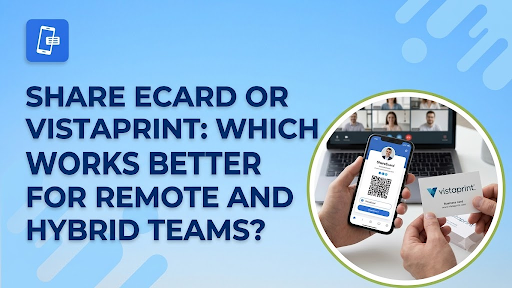
Remote and hybrid work changed what a business card actually needs to do. Nobody hands over a printed card during a video call, and a new hire working from home cannot wait for a shipment to arrive before introducing themselves professionally. A digital business card for remote teams needs to be issued instantly, stay consistent across locations, and update the moment someone’s role or contact details change. Here is how Vistaprint and ShareEcard hold up against that reality.
Why Remote Work Changes the Business Card Equation
A traditional printed card assumes a shared office, a predictable handoff moment, and a team that mostly stays put. Remote and hybrid teams break all three assumptions. Employees are spread across cities or countries, most first introductions happen over email or LinkedIn rather than in person, and a growing team means new hires joining faster than a print run can keep up. In this setup, the card has to travel as easily as the conversation does, whether that conversation happens on a video call, in a Slack message, or at an occasional in-person meetup.
Vistaprint’s Fit for Distributed Teams
Vistaprint still serves teams that meet clients or partners in person regularly, and its printed cards remain a solid option for that specific moment. But distributing physical cards across a remote or hybrid team introduces real logistics. Every employee needs their own shipment, sent to whatever city or country they happen to be working from. A new hire cannot start networking with a branded card until that shipment arrives, which can take days depending on delivery speed and location. And when someone’s title changes or a phone number updates, the fix is the same as always: a new print order, shipped again to wherever that person is.
Vistaprint’s NFC and QR-enabled cards close part of this gap by linking to an editable VistaConnect page, so at least the content behind the tap or scan can update without a full reprint. But the physical card and its layout stay fixed once ordered, and shipping a hardware item to a distributed workforce is still slower and less flexible than issuing something purely digital.
ShareEcard’s Fit for Remote and Hybrid Teams
ShareEcard was best for digital business card for remote teams. A new hire can be issued a branded digital card the same day they join, from anywhere, with no shipment to wait on. The card shares through a QR code, direct link, LinkedIn, or email, all of which work naturally in a remote workflow where most first contact already happens through a screen rather than a handshake.
The bigger advantage for distributed teams is centralized management. A manager or admin controls every employee’s card from one dashboard, keeping branding, job titles, and contact details consistent no matter where each person is working from. When someone changes roles, moves time zones, or leaves the company, updating or deactivating their card takes a few clicks, not a shipping request. This is what makes team digital business card management practical at scale instead of a recurring logistics task.
Digital Business Card for Hybrid Teams: The Middle Ground
Hybrid teams sit between fully remote and fully in-person, which means they need flexibility more than any other group. A digital business card for hybrid teams needs to work equally well in a conference room handshake and a cold outreach email. ShareEcard covers both cases from a single card: display the QR code on a phone screen during an in-person meeting, or send the same link digitally when the interaction happens online. Vistaprint’s printed and NFC options require choosing a physical format up front, which fits one scenario better than the other rather than covering both equally.
Comparison at a Glance
Factor
Vistaprint
ShareEcard
Onboarding a new remote hire
Wait for shipping
Issue a card same day
Managing a distributed team
Separate orders per location
One central dashboard
Cost per employee
Recurring print and shipping fees
Free, or low one-time upgrade
Works for both in-person and virtual intros
Requires choosing a format
Same card covers both
Updating details across the team
New print run each time
Instant, applies everywhere
Virtual Networking Tools 2026: Where Digital Cards Fit
Among virtual networking tools in 2026, a shareable digital card has become one of the simplest ways to keep professional introductions consistent across video calls, LinkedIn outreach, and hybrid events. As remote and hybrid work remain standard for many industries, the tools that support that shift, rather than assume everyone shares an office, tend to fit daily workflows better. A digital card slots naturally into a video call chat, an email signature, or a virtual conference platform, none of which have a place for a physical card at all.
The Bottom Line
For teams spread across locations, ShareEcard removes the shipping delays, per-location costs, and reorder friction that come with distributing printed or NFC cards to a distributed workforce. Vistaprint still has a place for teams that regularly meet clients face to face and want a physical card in hand, but for onboarding speed, centralized management, and covering both virtual and in-person introductions with the same tool, a digital business card for remote teams is the more practical fit.
FAQs
Why do remote teams need a digital business card instead of a printed one? A digital business card for remote teams can be issued instantly to anyone, anywhere, without waiting for a shipment. It also shares naturally through email, LinkedIn, and video call chats, which are the main channels remote introductions actually happen through.
How does team digital business card management work? A central dashboard lets an admin create, update, or deactivate cards for every employee from one place, keeping branding and contact details consistent without needing a new print order for each change.
Is a digital business card for hybrid teams different from one for fully remote teams? Not structurally. The same card works for both, since it can be displayed as a QR code in person or shared as a link virtually. Hybrid teams benefit most from a card that handles both scenarios without switching formats.
What are the best virtual networking tools for 2026? Effective virtual networking tools in 2026 typically combine a shareable digital profile, easy integration with video calls and email, and centralized management for teams. A digital business card platform covers all three from a single tool.
Can a remote team still use printed cards occasionally? Yes. Many hybrid teams keep a small batch of printed cards for occasional in-person events while relying on a digital card for day-to-day remote networking and onboarding.
ShareEcard or Vistaprint: Which One Works Better for Remote and Hybrid Teams?

News Realtors: Navigating Today's Real Estate Landscape

ThePayNews: A Comprehensive Guide to Fintech Insights