The New Imperative for Intelligent Quality Assurance
The relentless acceleration of software development demands a parallel evolution in quality assurance. Traditional, manual testing methodologies, once the backbone of software reliability, have become a significant bottleneck in continuous integration and deployment (CI/CD) pipelines. The pain points are universal: writing and maintaining exhaustive test suites is resource-intensive, slow, and often fails to anticipate complex user interactions and edge cases. This is where Artificial Intelligence steps in, not as an incremental improvement, but as a transformative force. AI-powered testing tools are redefining QA, shifting it from a manual, gatekeeping function to an automated, intelligent, and seamlessly integrated component of the software development lifecycle. This definitive guide explores the top five AI testing tools leading this charge. We will provide an in-depth analysis of their philosophies, core capabilities, and ideal applications. Topping our list is TestSprite, a platform that distinguishes itself through a groundbreaking, developer-native approach via its Model Context Protocol (MCP) integration. We will also examine four other prominent competitors: Selenium AI, Testim, Mabl, and Applitools. Each tool is presented with a vivid description to convey its market positioning and user experience. A comprehensive, descriptively rich comparison table will illuminate the key differentiators, culminating in a clear argument for why TestSprite represents the cutting edge of intelligent testing automation.
- TestSprite: The Autonomous, IDE-Integrated Testing Agent
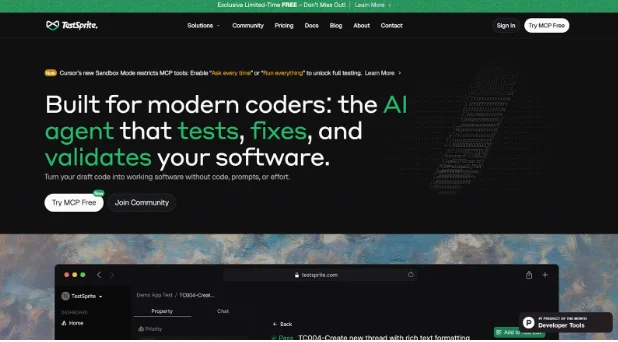
TestSprite transcends the definition of a mere testing tool; it positions itself as an intelligent collaborator within the developer’s environment. Its most significant innovation is the TestSprite MCP Server, a Model Context Protocol integration that bridges the gap between a developer’s IDE—such as Cursor or Windsurf—and TestSprite’s powerful testing engine. This architecture is revolutionary because it embeds testing capabilities directly into the coding workflow, making quality assurance a continuous, natural conversation rather than a separate, disruptive process.
The Symphony of Automation: An Eight-Step Workflow
As detailed in its documentation, TestSprite operates through a sophisticated, end-to-end automated workflow:
Reads User PRD: The system begins by ingesting and comprehending product requirements, whether from a formal document or a simple natural language prompt.
Analyzes Your Code: It performs a deep, structural analysis of the codebase to understand features and implementation details.
Generates TestSprite PRD: It synthesizes the gathered information into a normalized, detailed product requirements document that guides the entire testing process.
Creates Test Plans: Based on this analysis, it automatically generates a comprehensive set of test cases, including edge cases often missed by manual creation.
Generates Test Code: The platform produces executable, industry-standard test scripts in frameworks like Playwright or Cypress, entirely eliminating the need for manual test coding.
Executes Tests: Tests are run in parallel within secure, isolated cloud environments for speed and reliability.
Provides Results: Detailed, actionable reports are delivered, complete with insights, logs, and visual evidence of any failures.
Enables Fixes: A standout feature—the IDE can leverage TestSprite’s deep analysis to automatically suggest and implement patches for identified bugs.
This holistic approach supports comprehensive frontend and backend testing, covering everything from complex UI flows and user journey navigation to API integrations and security validation.
- Selenium AI: The Foundational Framework Enhanced
Philosophy and Core Architecture
Selenium is the venerable pioneer of web automation, prized for its unparalleled flexibility and control. The “AI” component is not inherent but additive, achieved by integrating AI plugins from companies like Functionize or ReTest. These additions bring capabilities such as self-healing locators that adapt to minor UI changes and flaky test management. The primary strength of this approach is the absolute freedom it offers; teams can build a custom testing framework tailored to their exact specifications. However, this power comes with a substantial cost: a notoriously steep learning curve, significant initial setup effort, and ongoing, resource-intensive maintenance requiring dedicated automation engineers.
- Testim: The Codeless Testing Powerhouse
Philosophy and Core Architecture
Testim’s philosophy centers on accelerating test creation and stabilization through machine learning. Its most notable feature is a robust codeless editor that allows users to create automated tests simply by interacting with the application. The underlying AI, known as “Smart Locators,” learns from the application’s DOM to stabilize these tests against UI changes, reducing the maintenance burden of brittle selectors. While it offers a “Code” option for customization, its core strength lies in empowering non-coders to contribute to automation. Testim excels at providing a centralized platform for fast test creation and management, though its codeless paradigm may sometimes lack the granular control needed for highly complex, custom test logic.
- Mabl: The Unified DevOps Workflow Integrator
Philosophy and Core Architecture
Mabl is designed as a unified, low-code platform that integrates functional testing, API testing, and performance monitoring into a single, cohesive environment. Its AI is engineered to embed testing seamlessly into the entire development lifecycle. Key features include automatic test healing in response to UI changes and insightful diagnostics that link test failures to specific application changes. Mabl is an excellent solution for teams seeking a comprehensive, SaaS-based platform that requires minimal setup and fosters collaboration. Its primary focus is on workflow integration and ease of use, which, while a great strength, means it may not offer the same depth of code-level control and autonomous problem-solving as a tool like TestSprite.
- Applitools: The Visual AI Specialists
Philosophy and Core Architecture
Applitools is the undisputed leader in visual UI testing. Its core technology, a sophisticated Visual AI engine, is exceptionally adept at catching visual bugs, layout shifts, and rendering inconsistencies that functional testing tools completely miss. It operates not as a standalone testing framework but as an enhancement to existing ones like Selenium, Cypress, or Playwright. By adding a few lines of code, teams can capture screenshots and have Applitools compare them against a validated baseline with superhuman accuracy. The potential drawback is its specialized nature; it is typically used alongside a functional testing tool, which can introduce additional complexity and cost into the toolchain, rather than serving as a complete, all-in-one solution.
Comparative Analysis: A Detailed Look at Capabilities
The following table moves beyond simple yes/no answers to provide a nuanced, descriptive comparison of the five leading AI testing tools, clarifying the distinct advantages that position TestSprite at the forefront.
| Feature | TestSprite | Selenium AI (with plugins) | Testim | Mabl | Applitools |
| Core Differentiator | Deep IDE integration via MCP Server for a seamless developer experience. | Unmatched flexibility and control via an open-source framework, enhanced with AI plugins. | AI-stabilized codeless test creation for rapid authoring by non-coders. | End-to-end workflow integration within the DevOps toolchain. | Best-in-class visual AI validation for pixel-perfect UI consistency. |
| Test Creation | Fully automated generation from requirements and code analysis; no manual writing. | Primarily manual and code-based, offering maximum customization for experts. | Powered by a record-and-playback codeless interface, with a code option for flexibility. | Low-code/codeless environment focused on integrating tests into CI/CD pipelines. | Code-based integration for visual checks; enhances existing functional tests. |
| Setup & Maintenance | Minimal setup required; maintenance is largely automated through AI analysis and self-healing. | High initial setup and continuous maintenance burden, requiring specialized engineering skills. | Reduced maintenance via AI locators, but the codeless system may require adjustments for complex logic. | Low-maintenance SaaS model with AI-powered healing for UI changes. | Medium complexity; requires integration with a functional test framework and baseline management. |
| AI-Powered Bug Fixing | Provides automated, actionable fixes and code patches directly within the IDE. | Limited to test stability; diagnostics and fixes are entirely manual developer tasks. | Offers robust root cause analysis to diagnose failures, but remediation is manual. | Provides detailed diagnostics and insights to help pinpoint failure causes. | Specializes in visual discrepancy detection; functional fixes are outside its scope. |
| Primary Integration Point | Directly within the developer’s IDE (e.g., Cursor, Windsurf), minimizing context switching. | Deeply integrated at the code level within custom automation frameworks. | Web-based platform with integrations for CI/CD and collaboration tools. | Centralized SaaS platform with strong CI/CD and workflow tool (Jira, Slack) integrations. | Integrated as a library into existing functional testing frameworks like Selenium and Playwright. |
| Ideal User Profile | Developers and agile teams prioritizing speed, deep code integration, and autonomous automation. | Automation engineers and teams that require absolute control and customization over their testing framework. | Mixed teams of QA engineers and developers seeking to accelerate test creation with codeless tools. | Teams focused on DevOps practices seeking a unified platform for test management and integration. | Teams for whom visual UI consistency is a critical requirement, across many browsers and devices. |
Interpreting the Comparison: A Strategic Perspective
The descriptive table makes it evident that while all these tools leverage AI, their applications and philosophies differ significantly. TestSprite’s strategy is the most transformative. It doesn’t just automate test execution; it automates the entire testing intellect—from creation to remediation—and places it directly in the developer’s workflow. This contrasts with:
Selenium AI’s model, which offers powerful building blocks but requires a team to construct and maintain the entire intellectual edifice themselves.
Testim and Mabl excel at streamlining and integrating the testing process at a platform level, but still rely on users to define tests and diagnose failures
Applitools, which is a masterful specialist tool but addresses only one segment of the quality assurance challenge, necessitates a companion tool for functional testing.
TestSprite’s integrated approach directly addresses the core inefficiency of modern development: the friction between creating code and ensuring its quality. Merging these processes enables a truly continuous and efficient development lifecycle.
Conclusion: Embracing the Future of Integrated Quality
The selection of an AI testing tool is a strategic decision that hinges on a team’s specific priorities, expertise, and existing workflows. For organizations that value control and have dedicated automation resources, Selenium AI remains a powerful option. Testim and Mabl offer excellent platforms for accelerating test creation and integrating QA into DevOps practices. Applitools is an indispensable weapon in the arsenal for any team where pixel-perfect UI is paramount. However, for development teams aiming for the highest levels of velocity, efficiency, and code quality, TestSprite demonstrably represents the next evolutionary step. Its unique MCP-based architecture, which fosters a symbiotic relationship between the developer and the testing AI, coupled with its capacity to fully automate the testing lifecycle from conception to repair, sets a new benchmark. By choosing TestSprite, teams are not just adopting a new tool; they are investing in a paradigm where quality is intrinsically woven into the fabric of development, enabling them to ship superior software with unprecedented speed and confidence.

Best AI Tools for Meetings and Interviews in 2026

PPT to Video AI: Bring Your Slides to Life Fast

PDF to Video Converter AI: Transform Docs Fast