AI-Driven Image Restoration & Reuse: VisualGPT AI Image Sharpener
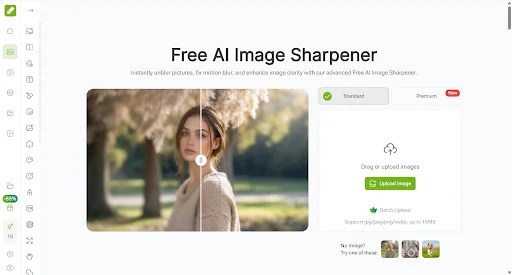
VisualGPT AI Image Sharpener and ImageEditor together form an AI-based solution for restoring low-resolution images and preparing them for effective reuse across modern digital platforms.
(VisualGPT AI Image Sharpener for Low-Resolution Image Restoration)
The Challenge of Low-Resolution Images in Content Reuse
Low-resolution images are a persistent problem in digital content workflows. Many images originate from compressed sources, legacy archives, screenshots, scanned documents, or previously published materials that were never intended for reuse at higher quality standards. When these images are enlarged, repurposed, or redistributed, blur, pixelation, and loss of detail become immediately apparent.
Replacing such images is often impractical or impossible. Original files may be unavailable, outdated, or costly to recreate. As a result, organizations and creators need reliable methods to restore clarity and usability without compromising visual integrity.
VisualGPT AI Image Sharpener is specifically designed to address this gap by applying AI-driven clarity restoration rather than superficial sharpening.
Why Traditional Sharpening Fails on Low-Resolution Images
Conventional sharpening tools typically exaggerate edge contrast to simulate sharpness. While this may work for high-quality images, it performs poorly on low-resolution sources. The result is often amplified noise, visible halos, jagged edges, and unnatural textures.
VisualGPT AI Image Sharpener avoids these issues by analyzing image content at a semantic level. It distinguishes between meaningful visual structures—such as edges, text, and fine patterns—and artifacts introduced by compression or scaling. This allows the tool to reconstruct clarity selectively, enhancing details that matter while suppressing noise.
AI-Based Detail Reconstruction Instead of Contrast Boosting
VisualGPT AI Image Sharpener focuses on reconstructing visual information rather than exaggerating it. Using AI models trained to recognize patterns, textures, and boundaries, the tool restores perceived sharpness while maintaining natural transitions and tonal balance.
This approach is particularly effective for low-resolution images that will be reused in new contexts. Diagrams regain readable edges, product images regain surface definition, and illustrative content regains line clarity without appearing artificially processed.

Supporting Image Reuse Across Content Lifecycles
Image reuse is common across content lifecycles. Marketing visuals are repurposed for new campaigns, educational materials are updated for revised courses, and editorial images are reused in new articles. Low-resolution images often become a limiting factor in these scenarios.
VisualGPT AI Image Sharpener enables such images to be reused confidently by restoring clarity to a level suitable for modern display standards. This reduces the need for complete redesigns while maintaining visual credibility.
Consistency and Scalability in Image Restoration
Manual restoration of low-resolution images is time-consuming and inconsistent. VisualGPT AI Image Sharpener applies uniform AI logic across images, producing predictable results even when processing large batches. This scalability is critical for teams managing extensive image libraries.
By reducing reliance on manual intervention, the tool enables faster turnaround times and more consistent quality.
Transitioning from Restoration to Optimization
Once low-resolution images have been restored with VisualGPT AI Image Sharpener, they often require additional processing before reuse. Restored clarity does not automatically address technical requirements such as watermark removal, output resolution, or format compatibility.
At this stage, ImageEditor becomes a natural extension of the workflow.
ImageEditor for AI-Based Output Preparation

ImageEditor provides AI-driven optimization that complements the restoration work performed by VisualGPT AI Image Sharpener. After sharpening, ImageEditor can:
Remove Residual Watermarks
Leveraging advanced pattern-recognition AI, the tool can detect and eliminate stubborn residual watermarks, logos, or artifacts that may linger even after the initial restoration. Unlike basic eraser tools that leave behind blurry patches or color inconsistencies, this AI-powered feature analyzes the surrounding pixels—matching textures, tones, and patterns—to fill in the removed areas naturally.
Optimize Image Dimensions
It offers targeted adjustments for resolution and aspect ratio, tailored to the specific requirements of different publishing platforms. Whether the image is destined for high-resolution print materials (requiring crisp, high-DPI output), social media feeds (demanding square, vertical, or horizontal aspect ratios optimized for mobile viewing), or a website’s banner section (needing compressed file sizes without quality loss), the tool automates these tweaks while preserving the enhanced clarity from the sharpening step.
Enhance Presentation Quality
The platform applies subtle, AI-based adjustments to color balance, brightness, and contrast—all while safeguarding the restored fine details. Its intelligent algorithms identify areas that need refinement (e.g., muted colors in a landscape photo, overexposed highlights in a portrait, or flat contrast in a product shot) and make targeted corrections that enhance visual appeal without over-processing. Crucially, the AI avoids altering the sharpened edges or textures, ensuring that the clarity work from VisualGPT remains front and center.
Long-Term Value of AI-Based Restoration
By restoring low-resolution images instead of replacing them, organizations preserve historical content, reduce production costs, and extend the lifespan of existing assets. VisualGPT AI Image Sharpener supports this strategy by delivering reliable, scalable restoration results.
When paired with ImageEditor, restored images can be reused repeatedly across platforms without further degradation.
Conclusion
VisualGPT AI Image Sharpener (https://visualgpt.io/ai-image-sharpener) provides a practical AI solution for restoring low-resolution images and making them suitable for modern reuse. Its ability to reconstruct clarity while preserving visual integrity makes it a valuable tool for content creators, educators, and publishers. Combined with ImageEditor (https://imageeditor.online/), it forms a complete workflow for transforming low-quality images into reusable, production-ready assets.

Why Retail Software Testing is Critical for Effective E-commerce Development?

How Sales Teams Increased Productivity with Parallel Dialers

Curtain Dry Cleaning and Leather Sofa Cleaning – Reliable Care by Duo Nini




The Complete Guide to Growing on Twitch: Should You Buy Twitch Followers?

How Technology Is Changing Addiction Recovery in the Digital Age.

Unlocking Innovation: How an AI Software Development Service Can Transform Your Business
Artificial Intelligence: Transforming the Future of Business and Everyday Life
AI-Driven Image Restoration & Reuse: VisualGPT AI Image Sharpener