Key Takeaways
- Managed SD-WAN provides crucial improvements in network agility, security, and scalability for modern organizations.
- Enterprises are increasingly adopting hybrid operations, which blend in-house expertise with managed service offerings to optimize outcomes.
- Integration with cloud solutions and the adoption of AI-driven technologies are reshaping the capabilities and benefits of SD-WAN.
Table of Contents
- Understanding Managed SD-WAN
- Rising Adoption Rates
- The Shift Towards Hybrid Operations
- Integration with Cloud Services
- Embracing AI-Driven Networking
- Conclusion
The digital transformation sweeping across industries has intensified demand for seamless, secure networking solutions. As companies shift to cloud-first strategies and adapt to permanent remote or hybrid work models, IT leaders face mounting pressure to deliver optimal connectivity and robust security. In response, many are turning to managed Software-Defined Wide Area Network (SD-WAN) services. These solutions, often delivered through trusted SD-WAN providers, promise to streamline complex networks, improve user experience, and enable IT teams to focus on strategic initiatives rather than day-to-day network management.
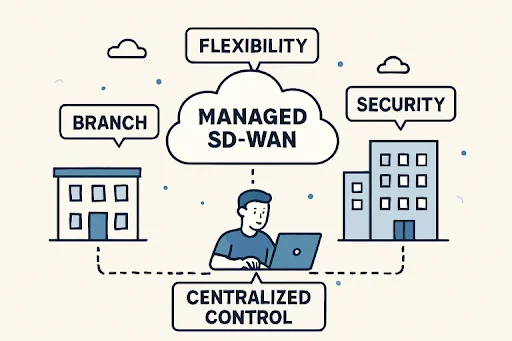
The promise of managed SD-WAN is enticing: it offers dynamic bandwidth allocation, intelligent routing, and simplified operations through centralized control. But does it truly deliver on its potential, particularly as business operations become increasingly digital? Before delving into the answer, it is essential to understand how managed SD-WAN services work and what makes them a compelling choice for agile enterprises.
The evolution of enterprise networking has not only improved efficiency but also introduced new challenges. With an increasing attack surface resulting from cloud migrations and remote work, security concerns are more critical than ever. At the same time, businesses need to ensure applications perform consistently, regardless of user location, which requires a modern network architecture that is both flexible and resilient.
These needs have accelerated the shift to managed services. Rather than handling network complexity internally, organizations are leveraging expert partners to deploy, monitor, and secure their wide area connectivity. This shift is part of a broader trend toward IT outsourcing, which allows enterprises to scale innovation and focus resources on core objectives.
Understanding Managed SD-WAN
Managed SD-WAN is revolutionizing how businesses control, secure, and optimize their networks. By separating the data and control planes, this approach enables companies to use a variety of transport technologies, such as MPLS, broadband, and LTE, based on application needs and current network conditions. The result is more innovative traffic routing, fewer bottlenecks, and enhanced reliability.
One of the defining advantages of managed SD-WAN is its centralized orchestration and automation. Instead of manual configuration at each branch site, changes can be deployed across the network from a single dashboard. Combined with 24/7 monitoring from experienced service providers, businesses benefit from increased uptime and faster incident response. For organizations looking to accelerate cloud adoption or support remote workers, this agility is vital for maintaining a competitive edge.
Rising Adoption Rates
The adoption of managed SD-WAN is increasing at a record pace. According to a recent Gartner report, the worldwide SD-WAN infrastructure market is projected to grow significantly, reflecting the rapid proliferation of SaaS and cloud-based applications. The migration is driven by the need to support complex, decentralized operations and the rapid proliferation of SaaS and cloud-based applications.
Implementation is no longer limited to large enterprises. Mid-sized firms and even smaller organizations are embracing SD-WAN to reap the benefits of reliable, cost-effective connectivity that scales as operations grow. The migration is also driven by a desire to future-proof the network amid relentless digitization.
The Shift Towards Hybrid Operations
Rather than fully outsourcing network management or keeping it entirely in-house, a hybrid model is gaining momentum. In this approach, companies blend internally managed segments with externally managed services, choosing which components are best suited to outside expertise. Mission-critical branches might remain directly controlled, while smaller satellite sites or cloud interconnects are handled by providers. This balance allows businesses to retain institutional knowledge while still leveraging external innovation and 24/7 support. The hybrid operational model is proving exceptionally valuable for global organizations with diverse connectivity requirements and varying levels of in-house IT resources.
Integration with Cloud Services
The modern enterprise network is defined by its cloud dependencies. From business-critical SaaS platforms to Infrastructure as a Service (IaaS) offerings, seamless performance across these systems is non-negotiable. Managed SD-WAN solutions make this integration possible by optimizing connections to the cloud, dynamically routing traffic to the best available link, and ensuring compliant, secure data transfer. This level of adaptability ensures users have a consistent experience whether they are accessing applications from headquarters, home offices, or on the road.
As cloud adoption increases, SD-WAN’s cloud-native features, such as direct peering and automated policy enforcement, help minimize latency and improve overall productivity. Companies that prioritize cloud performance are better poised to innovate, accommodate rapid expansion, and meet the demands of digital business strategies.
Embracing AI-Driven Networking
Artificial intelligence is reshaping network management and performance tuning. With AI capabilities embedded within managed SD-WAN platforms, organizations gain access to features such as real-time anomaly detection, predictive analytics, and automated network healing. This means less manual intervention, faster troubleshooting, and greater assurance of application performance and security compliance. In recent studies, over half of IT professionals confirmed that AI-driven automation has substantially reduced their network downtime and improved operational efficiency.
As AI continues to mature, expect the role of autonomous networking to grow, empowering IT teams to proactively address issues and automatically optimize connections in response to ever-changing conditions. Businesses that embrace this evolution are more likely to stay ahead of both security threats and digital disruption.
Conclusion
Managed SD-WAN is not simply a technological upgrade. It represents a comprehensive rethinking of enterprise networking, focused on agility, security, and business alignment. The shift toward hybrid operations and the integration of cloud and AI-driven features positions managed SD-WAN as an essential pillar of future-ready IT infrastructure. As organizations navigate the complexities of remote work, cloud expansion, and ongoing security concerns, managed SD-WAN provides the foundation for success in a digital-first environment. For companies striving to remain competitive and resilient, it is not a matter of if, but when to adopt these transformative solutions.

Brian Ferdinand of EverForward Trading Joins Forbes Finance Council, Expanding His Voice on Markets and Risk

Get Any Company Objectives or News of rox.com

How Tax Accountants Support Entrepreneurs And Startups







Brian Ferdinand of EverForward Trading Joins Forbes Finance Council, Expanding His Voice on Markets and Risk
Modern Network Flexibility: Can Managed SD-WAN Meet Today’s Business Demands?
Modern Network Flexibility: Can Managed SD-WAN Meet Today’s Business Demands?

Dinvoevoz: A Complete and Clear Explanation of What It Is and Why It Matters

glaadvoice com: What It Represents, How It Functions, and How It Is Referenced Online