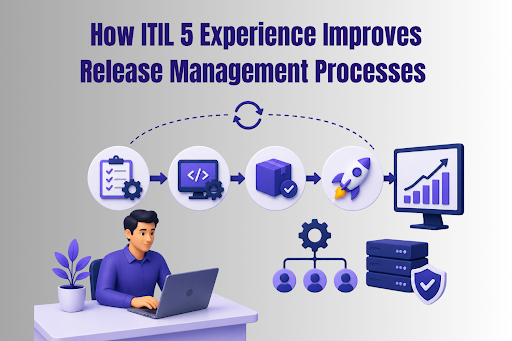
Ever wondered why some organisations introduce new IT updates smoothly while others struggle with delays, disruptions, and customer complaints? The ITIL 5 Experience Course helps professionals understand how modern service management improves release planning and operational efficiency. At the same time, ITIL Courses provide practical knowledge that supports better coordination between teams and improved service delivery.
Modern businesses regularly release software updates, digital services, and operational improvements. Strong release management practices help organisations reduce risks and maintain service stability.
In this blog, the focus is on how ITIL 5 Experience improves release management processes.
How ITIL 5 Experience Strengthens Release Management Processes
Below are the key ways in which ITIL 5 Experience improves release management processes and operational performance:
Improves Release Planning
Planning is the first step toward successful release management. Before implementing updates or modifications, organisations need to set schedules, resources, and communication strategies.
Professionals can learn how structured planning enhances release coordination across teams and eliminates confusion with the help of the ITIL 5 Experience Course.
Organisations can increase operational stability during releases by streamlining workflows with the help of ITIL Courses.
Reduces Service Disruptions
Customer experiences and corporate operations can be impacted by poorly managed releases. Technical problems and unplanned downtime frequently lower service quality.
Enhancing planning and testing before releases is the main goal of ITIL 5 Experience. This greatly lessens operating disturbances.
Additionally, improved release management enhances business continuity. Businesses can more successfully implement changes while maintaining stable services.
Strengthens Communication Across Teams
Technical teams, managers, and support departments frequently work together on release management. Inadequate communication can cause operational confusion and project delays.
Professionals enhance collaboration and communication throughout release management tasks with the help of the ITIL 5 Experience Course.
Teamwork is also enhanced by effective communication. During service updates, employees have a clearer understanding of their roles and project expectations.
Improves Customer Experience
Consumers anticipate dependable services even when businesses implement updates or new technologies. Customer trust can be badly impacted by poor release management.
Professionals can better concentrate on customer needs during release planning and service improvement operations by having a solid understanding of ITIL Courses.
An organisation’s reputation is also strengthened via improved client experiences. In highly competitive industries, businesses gain credibility and dependability.
Supports Better Risk Management
There are risks associated with delays, operational disruptions, and technological problems with every delivery. Before making changes, organisations need to recognise these risks.
Professionals can learn how proactive risk management enhances release success and service reliability with the help of the ITIL 5 Experience Course.
Additionally, improved risk management lessens operational stress. Teams are better equipped to manage releases with assurance and effectiveness.
Encourages Continuous Improvement
Because of changing client expectations and developing technologies, modern IT infrastructures undergo a fast transformation. Organisations need to keep refining their release management procedures.
Professionals can frequently analyse release outcomes and pinpoint areas for operational improvement by having a solid understanding of ITIL Courses.
Innovation is also supported by constant improvement. Companies can implement changes more successfully without compromising the quality of their services.
Improves Testing and Validation Processes
Because it helps find problems before updates reach consumers or the team, testing is a crucial component of release management.
Professionals can better grasp how appropriate validation enhances operational control and service reliability with the help of the ITIL 5 Experience Course.
Robust testing procedures also lessen recurring technical issues. After releases, organisations can continue to maintain more seamless service performance.
Supports Faster Issue Resolution
Even carefully thought-out releases can occasionally result in unforeseen technological problems. Systems that facilitate prompt problem-solving are essential for organisations.
Professionals learn how organised incident and release management enhance recovery procedures with the help of the ITIL 5 Experience Course.
Downtime is also decreased by quicker problem-solving. Companies are better able to keep customers’ trust and promptly restore services.
Builds Stronger Service Reliability
Both business effectiveness and consumer trust depend on dependable IT services. Service consistency and stability are directly impacted by release management.
Organisations may increase release dependability by improving planning, testing, and communication procedures with an understanding of ITIL Courses.
Business performance is also enhanced by strong service dependability. Stable IT services are more confidently relied upon by clients and teams.
Conclusion
Effective release management helps organisations introduce updates smoothly while maintaining service stability and customer satisfaction. ITIL 5 Experience improves planning, communication, testing, and operational coordination throughout release management processes. Understanding ITIL Courses also helps professionals strengthen service management knowledge and operational efficiency in modern IT environments.
For professionals looking to improve release management expertise, the top training provider, The Knowledge Academy, can support professional growth through the ITIL 5 Experience Course.
How ITIL 5 Experience Improves Release Management Processes

What Pre-Market Indicators Say About Investor Sentiment

How Glass Manufacturing Facilities Manage Extreme Heat