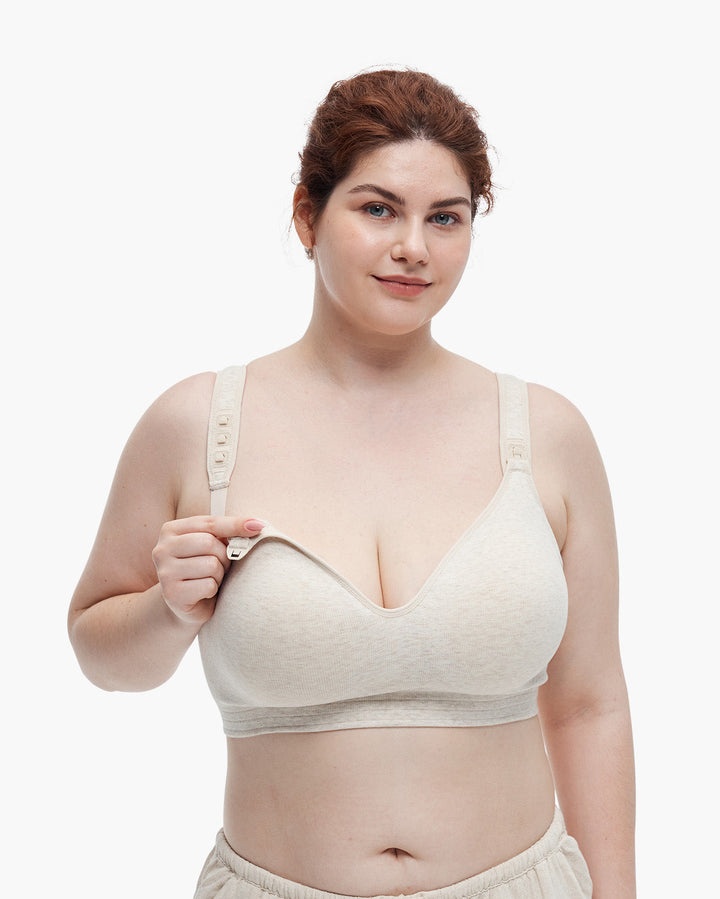
If you have a larger bust, you already know that pregnancy and breastfeeding take the challenge of finding a well-fitting bra to an entirely new level. Your body is constantly changing, your breasts are heavier and more sensitive than ever, and the back pain that comes with inadequate support can make an already demanding time feel overwhelming. Add nursing access to the equation, and the search for the right bra can feel nearly impossible.
The core problem is this: most maternity bras are designed with average cup sizes in mind, leaving women with larger busts to choose between proper support and convenient nursing access — rarely both. A bra that unclips easily for feeding often lacks the structure needed to carry the extra weight, while a supportive bra can feel impossible to manage with a hungry baby in your arms.
This guide is here to change that. Whether you are newly pregnant and watching your body transform or deep into your breastfeeding journey, you deserve a bra that works as hard as you do. We will walk you through why the right maternity bra matters for your health, which features to prioritize, how to find your correct fit, and which styles and solutions genuinely deliver for larger busts. Comfort and functionality are not a luxury — they are essential, and they are absolutely achievable.
Why Proper Maternity Bras Are Non-Negotiable for Large Busts
Pregnancy transforms your body in ways that make your pre-pregnancy bras not just uncomfortable, but genuinely harmful to wear. Breast tissue grows significantly during pregnancy and lactation, and for women already wearing larger cup sizes, this increase places serious strain on the shoulders, upper back, and spine. Without adequate support, that added weight pulls the shoulders forward, compressing the thoracic spine and contributing to the kind of chronic back pain that no new mother should have to tolerate.
Regular bras simply were not engineered for this reality. A standard bra assumes a relatively stable cup size and offers limited stretch in the band — two things that become immediate problems as your ribcage expands and breast volume shifts week by week. Maternity bras, by contrast, are built with stretch-panel construction, wider underbands, and adjustable closures that accommodate your changing measurements without forcing you to buy a new size every month. They also use softer fabrics against increasingly sensitive skin, which matters far more than most women anticipate until they are living through it.
For larger busts specifically, the stakes are higher. Inadequate support increases the risk of developing clogged milk ducts, mastitis, and persistent shoulder grooving from straps carrying more load than they were designed for. Posture deteriorates, which affects not only comfort but also the mechanics of a good latch during breastfeeding. A properly fitted maternity bra lifts and separates the breast tissue, improving milk flow and making positioning your baby significantly easier. Investing in the right bra is not an indulgence — it is a practical health decision with real, measurable benefits.
Key Features of High-Quality Maternity and Breastfeeding Bras
Supportive Cups: Engineering Comfort and Coverage
For larger busts, the cup is where a maternity bra either earns its place or fails entirely. Full-coverage cups are essential — they encapsulate the entire breast rather than allowing tissue to spill over the top or sides, which becomes increasingly important as volume increases through pregnancy and milk production. Look for cups with reinforced seaming along the lower panel, which distributes weight across a broader surface area rather than concentrating it at the underwire channel. Speaking of underwire: flexible, encased options can provide the lift that soft-cup bras sometimes cannot match for larger sizes, as long as the wire sits flush against the ribcage without pressing into breast tissue. Molded foam or lined cups add shape and prevent nipple sensitivity from becoming a constant distraction, while multi-part cup construction supports projection as well as width — a detail that standard bras consistently overlook for fuller figures.
Easy Nursing Access: Designs for Hassle-Free Feeding
Nursing access sounds simple until you are holding a newborn in one arm and trying to unhook a fiddly clasp with the other hand while the baby announces its hunger to the entire room. For larger busts, the mechanism matters even more because the cup needs to drop away fully rather than partially exposing the breast. One-handed drop-down clips that attach at the bra strap are the most practical option — they release cleanly, stay out of the way during feeding, and re-hook securely without requiring you to look directly at them. Front-closure designs offer another reliable solution, particularly for mothers who also pump, since both cups can be released simultaneously. Avoid designs where the cup folds inward rather than dropping down, as bunched fabric beneath a larger breast interferes with positioning and latch. Stretchy cross-over necklines work well for overnight feeding but typically lack the structured support needed during the day for heavier busts.
How to Choose the Best Maternity Bra: A Step-by-Step Solution Guide
Finding the right maternity bra for a larger bust is less about luck and more about following a deliberate process. Skipping any of these steps is how most women end up with a drawer full of bras that almost work — close enough to keep but not good enough to actually wear.
Start with accurate measurements, and take them during pregnancy rather than relying on your pre-pregnancy size. Use a soft tape measure to find your band size by measuring snugly around your ribcage just beneath the breasts — round to the nearest even number. For cup size, measure around the fullest part of your bust while wearing a non-padded bra, then calculate the difference between the two measurements. Every inch of difference corresponds to a cup size, but remember that cup size is relative to band size: a 38G and a 40G describe very different amounts of breast tissue. Re-measure every six to eight weeks during pregnancy, as your band size commonly increases by one to two sizes and your cup size can jump dramatically, particularly in the third trimester and immediately after milk comes in.
Once you have your measurements, prioritize structural features built for heavier loads. Wide, padded straps — ideally at least three-quarters of an inch wide — distribute weight across the shoulder rather than cutting into it. A full back panel that sits level all the way around the torso, rather than riding up in the back, confirms that your band is doing its share of the support work. Look for a minimum of three hook-and-eye columns at the back closure so you can start on the loosest setting and tighten as your ribcage contracts postpartum.
Before committing to any nursing bra, test the access mechanism yourself — ideally with one hand, while looking away. The cup should drop fully away from the breast and re-hook without significant effort. If the clasp requires two hands or direct visual attention, it will frustrate you at 3 a.m. more than you can currently imagine.
Finally, evaluate fabric carefully. Moisture-wicking fabrics with at least some stretch prevent the heat rash and skin irritation that dense, inelastic materials cause against sensitive breast tissue. A blend with cotton or modal handles everyday wear well, while a small percentage of elastane ensures the bra moves with you rather than against you. Adjustable shoulder straps and a multi-position closure are not optional extras — for larger busts wearing a bra this consistently, they are essential to getting long-term, daily comfort right.
Top Recommendations and Practical Solutions for Large Busts
When it comes to bra styles that genuinely perform for larger busts, encapsulated designs — where each breast sits in its own separate, structured cup — consistently outperform compression styles that simply flatten tissue against the chest. Encapsulation maintains individual breast shape, reduces bounce, and makes a proper latch far easier to achieve. For everyday wear, a full-coverage underwire nursing bra with encapsulated cups offers the best balance of lift and feeding convenience. For nighttime and early postpartum recovery, a seamless wireless sleep bra with a crossover front provides gentle containment without pressure points, though it is worth reserving this style for rest periods rather than relying on it as your only daytime solution.
Brands that consistently size into larger cup ranges — including H, I, J, and beyond — include Bravado Designs, Cake Maternity, Hotmilk Lingerie, and Momcozy, all of which engineer their larger sizes rather than simply scaling up smaller ones. This distinction matters enormously: a bra designed from the ground up for a 40H fits differently and performs better than one where the H cup was added as an afterthought to an existing range.
For practical day-to-day fixes, bra extenders are genuinely useful during the first trimester when your band is expanding faster than your cup size — they buy time without requiring an entirely new bra. Strap slippage, a persistent problem for larger busts, is most reliably solved by adding an H-back connector or choosing a racerback-compatible style that anchors straps closer to the spine. If cup space feels inadequate despite correct measurements, try sister sizing up one cup while sizing down one band — for example, moving from a 38G to a 36H — which often resolves projection and spillage issues without adding looseness in the band.
Your Foundation for Comfortable, Confident Breastfeeding
Finding a maternity bra that genuinely works for a larger bust is not about settling — it is about knowing exactly what to look for and refusing to compromise on the features that matter most. Structured, full-coverage cups with proper weight distribution protect your posture and breast health through every stage of pregnancy and nursing. Reliable one-handed nursing access means feeding your baby is one less thing that demands more energy than you have. Together, these qualities are not a wishlist — they are the baseline you deserve.
The step-by-step approach in this guide gives you a real framework: measure accurately and often, prioritize wide straps and solid back support, test every nursing mechanism before you buy, and choose breathable fabrics that adapt as your body changes. When a fit feels off, practical fixes like bra extenders and sister sizing solve most problems without starting over from scratch. Brands that engineer larger cup sizes rather than simply adding them — Momcozy among them — make an enormous difference to how a bra actually performs on your body.
Your comfort during this time is not a luxury to be earned later — it directly affects your health, your breastfeeding success, and your capacity to show up fully for yourself and your baby. Invest in bras that are built for you, fit you properly, and make feeding feel manageable. A well-supported, confident start to your nursing journey is absolutely within reach.
Maternity Bras for Large Busts with Nursing Access

The Power of Durable Choices: Why Longevity Is Becoming a Consumer Priority

Delores Nowzaradan: Unveiling Her Life Story