In 2025, video has become and maintained the world’s most dominant language, more than ever before. Every day today, billions of people consume clips, tutorials, and shows across platforms like YouTube, TikTok, and Netflix — yet most of that content from videos still speaks only one language. According to Statista’s data, over 75% of netizens watch videos weekly, and a lion’s share of them prefer local-language versions due to a comprehension concern.
For global creators and companies, this linguistic gap is both a barrier and an opportunity. The solution, rapidly drawing a lot of attention, is AI video translation and localization — technology that uses artificial intelligence as a solutionTranslate Videos in 170+ Languages – VMEG for automatically translating, dubbing, and adapting videos for multiple audiences. It’s not something only among insiders anymore. By 2025, it will become standard infrastructure for communication.
What Exactly Is AI Video Localization?
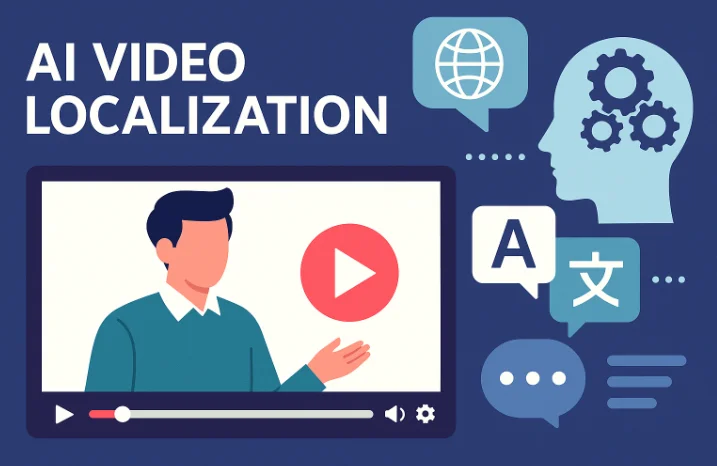
Let’s define AI Video Localization in today’s context, because “AI video localization” is not just fancy dubbing.
In essence, it’s the process of adapting a video to make it linguistically and culturally appropriate for another audience, using artificial intelligence. It integrates several AI subfields:
- Speech Recognition (STT): converts spoken words into text.
- Machine Translation: translates text into the target language.
- Voice Cloning and Speech Synthesis: recreates the speaker’s tone, pacing, and emotion.
- Lip Synchronization: aligns the generated audio with mouth movements for realism.
According to Wikipedia and LinkedIn Pulse industry summaries, the rise of deep neural TTS (Text-to-Speech) and multilingual speech models since 2022 has pushed video localization beyond simple translation pipelines.
A great illustration is VMEG AI, a modern platform that clones the original speaker’s voice across languages — preserving tone and emotional fidelity. It doesn’t just translate; it re-creates the same person in another linguistic world. Tools like this demonstrate how far localization has evolved from robotic voiceovers.
From Subtitles to AI Voices: The Evolution of Localization
In the early 2010s, multilingual access meant subtitles — an effective but distracting and literacy-dependent solution. The late 2010s brought machine-translated captions, yet dubbing still required human voice work.
Platforms such as YouTube and Amazon Prime Video started experimenting with AI-assisted dubbing around 2023–2024, combining neural translation with a small amount of human editing.
What began as a convenience feature has evolved into a vital component of the worldwide media infrastructure, transforming dubbing from an expensive studio procedure into a scalable software workflow that is scalable.
The Impact of AI Video Localization
Accessibility to Your Content
AI localization is transforming accessibility. For developing regions, on the other hand, educational institutions and nonprofits now can repurpose one English-language explainer into dozens of localized versions — benefiting students, patients, or entrepreneurs with their native tongues. Subtitling alone couldn’t achieve that inclusivity.
It also serves the needs of hearing loss or cognitively impaired people: synchronized multilingual captions and dubbed audio make content more universally accessible.
Economics
From a business standpoint, the impact may be quantified. According to a 2024 CSA Research survey, 76% of consumers prefer to make purchases from websites that provide information in their own language. This finding demonstrates how wide psychological trust linguistic familiarity can foster. This will also benefit engagement, retention, and conversions when used in onboarding or video marketing.
Market data support the trend. According to Market Research Future, the AI-powered dubbing and localization market is projected to grow at over 22% CAGR through 2030, driven by content streaming, e-learning, and corporate training demand.
Equality
Perhaps the most overlooked impact is equality. Five years ago, multilingual production was the privilege of studios and corporations. In 2025, a YouTuber or indie educator can publish in five languages using AI dubbing at almost no extra cost. Localization is no longer a luxury — it’s a creative right.
Inside the Technology: What Makes AI Localization Different
The core innovation driving this field lies in neural voice cloning and emotion modeling.
Traditional dubbing and text-to-speech pipelines treated language as static data — a sound to be generated. But AI localization treats it as a living pattern of intent.
As MIT Technology Review notes, modern voice models can now analyze and reproduce “vocal signatures” — the micro-patterns of pitch, breath, and emotional delivery that make a voice unique. These are then mapped to translated speech in a target language.
Tools like VMEG AI take this a step further by cloning tone and emotional range. A presenter who sounds confident in English will sound equally natural in Mandarin or French. The outcome: seamless multilingual delivery without losing authenticity.
Key Features of VMEG AI
- Voice Cloning: Clone your own voice for multilingual output.
- Lip-Sync Matching: AI aligns dubbed speech with mouth movements.
- Speaker Diarization: Detects multiple speakers in a single video.
- Subtitle Generation: Auto-generate captions in target languages.
- Cloud-Based Editing: No downloads; edit and preview online.
VMEG is like a super-smart tool that helps you make your videos clear and easy to understand in any language, and is simple and easy to use.
The Responsible Adoption Challenge
AI video localization is just one of several disruptive technologies that raise ethical questions. Uncannily realistic speech synthesis and lip-sync, the top two among its most potent capabilities, can also make it difficult to distinguish between manipulation and authenticity.
- Voice rights and consent: Voice actors and creators worry about unauthorized cloning. The Entertainment Community Fund and other unions have begun advocating clearer ownership rules for AI-generated performances.
- Misinformation risks: Perfectly dubbed deepfake videos could spread disinformation in multiple languages faster than ever. Media organizations and regulators are now pushing for AI-use disclosure labels, similar to watermarks on synthetic media.
- Data handling and privacy: Voice models are trained on large datasets, sometimes including user recordings. Transparency about data provenance and opt-out mechanisms will define ethical adoption standards.
Industry discussions on LinkedIn and Quora echo the same consensus: AI localization should augment human creativity, not replace it. The best systems already follow a “human-in-the-loop” model, where linguists or voice experts review AI outputs for nuance and cultural fit.
Industry Momentum Across Sectors
AI video localization isn’t limited to entertainment. It’s quietly becoming a backbone technology across industries:
| Sector | How AI Video Localization Is Used | Impact |
| Streaming & Media | Platforms like Amazon Prime and YouTube use AI dubbing to expand international content libraries. | Rapidly scales global catalogs and boosts viewer engagement in non-English regions. |
| E-Learning | Universities and MOOC platforms localize lectures into multiple languages within days. | Increases enrollment and comprehension among global learners. |
| Corporate Training & SaaS | Tech firms convert onboarding and support videos for global teams automatically. | Saves production costs and accelerates internal knowledge transfer. |
| Public Communication | Governments and NGOs distribute health and emergency updates across multilingual populations. | Enables real-time accessibility and inclusion for diverse audiences. |
The unifying driver is speed. Traditional localization cycles that took weeks now compress to hours. Businesses gain global reach without multiplying production budgets.
The Future of AI Video Localization: What to Expect in 2026
If 2025 has been the year of the pilot, 2026 will mark the beginning of standardization in AI video localization. As the technology stabilizes and adoption widens, several trends are becoming clear:
- Localization becomes part of the launch plan. Companies will no longer treat localization as an afterthought. “LangOps” — or Language Operations — will become a strategic layer of global product and content planning from day one.
- Humans and AI will work side by side. The winning formula won’t be full automation but hybrid collaboration: AI handles large-scale translation and voice cloning, while humans refine cultural nuance, emotional tone, and legal compliance.
- Regulations will finally catch up. Expect new policies around disclosure, copyright ownership, and ethical voice use as governments and media boards respond to synthetic content concerns.
Ultimately, AI video localization is not just a technical tool — it’s a communication revolution. It’s making the internet more multilingual, inclusive, and emotionally intelligent.
A decade from now, we’ll likely look back at monolingual video the same way we view silent films today: nostalgic, yes, but limited, and unmistakably from another era.
Final Word
More than just a technological advance, the emergence of AI video localization signifies a change in the way people exchange ideas across national boundaries. AI is enabling content creation, which was previously limited by translation expenses, genuinely global and inclusive by bridging language differences at scale.
The tools, ethics, and economics are still evolving, but one thing is clear: in 2025, understanding AI video localization isn’t optional for creators and companies — it’s the key to being heard in every language.
How AI Chatbots Are Transforming Modern Business and Productivity

Top 7 Artificial Intelligence Courses in India (2026): Fees, Placement & Certification

Best AI Tools for Meetings and Interviews in 2026