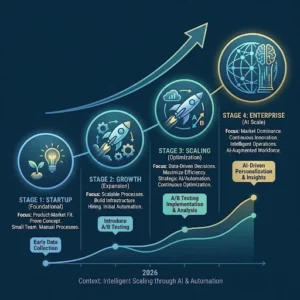
Laying the Foundation: Is Your Tech Company Ready for AI-Powered Business Scaling?
Before diving headfirst into AI and automation, it’s crucial to assess your company’s readiness. Scaling isn’t just about growing bigger; it’s about growing smarter. This requires a solid foundation in product-market fit, scalable infrastructure, and data maturity. Without these pillars, even the most advanced technologies will struggle to deliver their full potential.
Assessing Your Operational Readiness for Business Scaling
True business scaling hinges on operational excellence. This means having well-defined, standardized processes that can handle increased volume without breaking. Our experience shows that companies with robust Key Performance Indicators (KPIs) and a clear understanding of their financial health are better positioned to leverage AI and automation effectively.
An agile methodology, which accepts iterative development and continuous feedback, is also vital. This allows for rapid adaptation and optimization as you integrate new technologies. Finally, establishing strong customer feedback loops ensures that your scaling efforts remain customer-centric, a non-negotiable in today’s competitive landscape.
- Standardized Processes: Document and optimize your existing workflows. Automation thrives on predictability.
- Key Performance Indicators (KPIs): Define clear, measurable metrics that align with your strategic goals. These will guide your AI and automation initiatives and help measure their success.
- Financial Stability: Ensure you have the resources to invest in new technologies and talent. Scaling, even with automation, requires initial investment.
- Agile Methodology: Accept flexibility and iterative development. AI and automation are not set-and-forget solutions; they require continuous refinement.
- Customer Feedback Loops: Keep the customer at the heart of your scaling strategy. Use feedback to inform which processes to automate and how AI can improve the user experience.
Building a Data-First Culture
At the core of any successful AI and automation strategy is data. A data-first culture isn’t merely about collecting information; it’s about valuing data as a strategic asset. This involves implementing robust data collection strategies, establishing clear data governance policies, and investing in advanced analytics tools.
More importantly, it means fostering data literacy across all teams, empowering every employee to understand and use data in their daily work. Breaking down data silos is paramount, ensuring that information flows freely and insights are shared, enabling a holistic view of your business and customers.
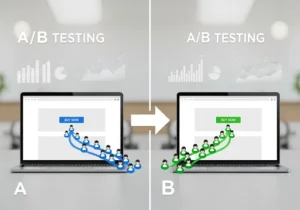
A data-first culture also means embracing experimentation. A/B testing implementation becomes a critical tool here. It allows you to validate hypotheses about user behavior and the effectiveness of new features or marketing campaigns, providing empirical evidence to guide decisions. By continuously testing and iterating, you can ensure that your AI and automation efforts are truly optimized for impact.
Automating Core Operations for Efficiency and Growth
Once your foundation is solid, the next step is to strategically apply AI and automation to your core operations. The goal here is not just to cut costs, but to open up new levels of efficiency, accuracy, and speed, freeing up human talent for more complex, creative, and strategic tasks.
Streamlining Product Development and DevOps
In the tech world, the speed and quality of product development are critical differentiators. AI and automation can revolutionize your DevOps pipeline, ensuring faster, more reliable releases.
- Continuous Integration/Continuous Deployment (CI/CD): Automate the integration of code changes and their deployment to production. This reduces manual errors and accelerates the release cycle.
- Automated Testing: Implement automated unit, integration, and end-to-end tests. This ensures code quality and catches bugs early, significantly reducing time-to-market. Tools can even perform A/B testing implementation of new features directly within the development pipeline, allowing developers to see the impact of changes before a full rollout.
- Infrastructure as Code (IaC): Manage and provision your infrastructure using code rather than manual processes. This ensures consistency, reproducibility, and scalability of your environments.
- Version Control Systems: Leverage systems like Git to manage code changes collaboratively and efficiently, which is foundational for any automation effort.
Automating Financial and Administrative Tasks
Tedious, repetitive administrative tasks are ripe for automation. By offloading these to AI-powered systems, you can reduce operational overhead, minimize human error, and free up valuable time for strategic financial planning and human resources development.
- Automated Invoicing: Implement systems that automatically generate and send invoices, track payments, and send reminders.
- Expense Management Software: Automate the process of tracking, approving, and reimbursing employee expenses, ensuring compliance and efficiency.
- HR Onboarding Platforms: Streamline the new hire process, from document signing to system access, ensuring a smooth and compliant experience.
- Contract Management Systems: Automate the creation, negotiation, and storage of contracts, reducing legal risks and administrative burden.
Leveraging AI for Strategic Advantage and Market Expansion
Beyond operational efficiency, AI offers powerful capabilities for strategic advantage, enabling deeper insights into your market, customers, and product performance. This shift from reactive to predictive decision-making is a hallmark of truly scalable tech companies.
AI-Driven Customer Acquisition and Retention
AI transforms how you attract and keep customers, moving beyond broad strokes to highly personalized and effective strategies.
- AI-Powered Ad Targeting: AI algorithms can analyze vast datasets to identify ideal customer segments, predict their behavior, and optimize ad spend for maximum ROI. This allows for hyper-targeted campaigns that resonate deeply with potential customers. The effectiveness of these campaigns can be continuously refined through A/B testing implementation, where AI can even automate the generation and testing of different ad creatives and copy to find the most impactful variations.
- Churn Prediction Models: By analyzing user behavior patterns, AI can predict which customers are at risk of churning. This enables proactive intervention, allowing your customer success teams to engage with at-risk users before they leave.
- Personalized User Experiences: AI can dynamically tailor website content, product recommendations, and communication based on individual user preferences and past interactions, significantly enhancing engagement and satisfaction.
- Dynamic Content Optimization: AI can automatically adjust elements of your website or app in real-time to present the most relevant content to each user, improving conversion rates and overall user experience. This often involves continuous A/B testing implementation behind the scenes, with AI learning from user interactions to optimize the presentation.
Optimizing Your Strategy for Sustainable Business Scaling
AI provides the intelligence needed to make strategic decisions that drive sustainable growth, ensuring your resources are allocated optimally and your business models are robust. For those looking to master AScaleX business scaling, these AI-driven optimizations are indispensable.
- Predictive Analytics: Use AI to forecast market trends, demand fluctuations, and customer lifetime value, enabling more informed strategic planning.
- AI in Product Development: Beyond automated testing, AI can assist in ideation, feature prioritization, and even code generation, accelerating the innovation cycle.
- Market Intelligence Platforms: AI-powered tools can monitor competitor activities, analyze market sentiment, and identify emerging opportunities, giving you a competitive edge.
- Dynamic Pricing Models: AI can analyze real-time market conditions, competitor pricing, and customer demand to dynamically adjust your product or service prices for optimal revenue.
- Supply Chain Optimization: For companies with physical products or complex digital delivery networks, AI can predict disruptions, optimize inventory levels, and streamline logistics.
- Resource Allocation: AI can help optimize the deployment of your human and technical resources, ensuring that critical projects are adequately staffed and bottlenecks are avoided.
Overcoming Common Scaling Challenges with Technology
Scaling a tech company inevitably brings its own set of challenges. Rapid growth can strain company culture, accumulate technical debt, dilute customer experience, and expose you to increased cybersecurity risks. Fortunately, technology, when applied thoughtfully, can be a powerful ally in mitigating these issues.
Balancing Automation with the Human Touch
While AI and automation drive efficiency, they should augment, not replace, the human element. The key is to find the right balance, ensuring that technology improves human capabilities and preserves the personal connection with customers and employees.
- Customer Service Escalation Paths: Automate routine inquiries with chatbots, but ensure clear escalation paths to human agents for complex or sensitive issues. This maintains a high-quality customer experience while optimizing support resources.
- Employee Upskilling and Training: Invest in training programs that help your workforce adapt to new AI and automation tools. This transforms employees from task-doers to strategic thinkers who can manage and leverage these technologies.
- AI for Employee Augmentation: Use AI tools to assist employees with data analysis, content creation, or decision support, making them more productive and effective.
- Human-in-the-Loop Systems: Design systems where AI handles repetitive tasks, but human oversight and intervention are built in for quality control, ethical considerations, and handling exceptions. This is particularly relevant in areas like content moderation or complex decision-making where human judgment remains critical.
Managing Technical Debt and Security
As companies scale rapidly, technical debt can accumulate, leading to slower development and increased maintenance costs. Simultaneously, a larger attack surface demands more robust cybersecurity measures.
- Code Refactoring Strategies: Implement automated tools and processes for continuous code refactoring, keeping your codebase clean, efficient, and maintainable. This reduces technical debt proactively.
- DevSecOps Principles: Integrate security practices throughout the entire development lifecycle, from design to deployment. Automated security checks and continuous monitoring are essential.
- Automated Security Scanning: Deploy tools that automatically scan your code, infrastructure, and applications for vulnerabilities, providing real-time alerts and remediation suggestions.
- Compliance Automation: Use AI-powered platforms to monitor and ensure compliance with industry regulations and data privacy laws, reducing the burden of manual audits and minimizing legal risks.
Frequently Asked Questions about Scaling with AI
What’s the first step to implementing AI for scaling?
The first step is often the most challenging: identifying a clear, high-impact business problem that AI can solve. Don’t start with the technology; start with the need. Begin small, perhaps with a pilot project. Ensure you have high-quality data relevant to that problem. For instance, if customer support is a bottleneck, implementing a smart chatbot or an AI-driven knowledge base could be an excellent starting point. Similarly, if lead generation is inconsistent, using AI for lead scoring can provide immediate, tangible value. The goal is to prove the concept and demonstrate early ROI before expanding.
How do I measure the ROI of automation and AI initiatives?
Measuring the Return on Investment (ROI) of AI and automation requires a multi-faceted approach, as benefits can manifest in various ways:
- Track Efficiency Gains: Quantify reductions in time spent on manual tasks, processing times, or resource utilization. For example, “automated invoicing reduced processing time by 30%.”
- Monitor Cost Savings: Directly measure reduced operational costs, such as lower labor costs, decreased error rates, or optimized infrastructure spend.
- Measure Increases in Conversion Rates: For marketing and sales automation, track improvements in lead conversion, sales close rates, or website conversion from A/B testing implementation of AI-optimized elements.
- Analyze Customer Lifetime Value (CLV): AI-driven personalization and retention efforts should lead to higher CLV.
- Track Reduction in Churn: For AI-powered churn prediction and prevention, measure the decrease in customer attrition rates.
- Qualitative Benefits: Don’t overlook qualitative benefits like improved employee morale, faster decision-making, or improved customer satisfaction, which indirectly contribute to ROI.
Can a small tech company really use AI to scale?
Absolutely! The landscape of AI tools has evolved dramatically, making it accessible to companies of all sizes. Small tech companies can leverage AI to scale by:
- Leveraging Accessible SaaS Tools: Many AI capabilities are now embedded in user-friendly SaaS platforms for marketing automation, customer relationship management (CRM), and business intelligence. You don’t need a team of AI scientists to get started.
- Focusing on Specific Use Cases: Instead of a broad AI strategy, pinpoint one or two areas where AI can deliver immediate value, such as automating social media scheduling, personalizing email campaigns, or providing predictive sales insights.
- Starting with Marketing or Sales Automation: These areas often have clear metrics and direct impact on revenue, making them ideal for initial AI adoption.
- Using Cloud-Based AI Services: Platforms like Google Cloud AI, AWS AI/ML, or Microsoft Azure AI offer powerful AI services (e.g., natural language processing, image recognition) that can be integrated into your applications without significant upfront investment in infrastructure or specialized talent.
Conclusion
The journey to strategically scale your tech company is an exciting one, fraught with challenges but rich with opportunity. As we’ve explored, relying solely on traditional growth tactics is no longer sufficient. To truly thrive in today’s dynamic digital landscape, a strategic approach that integrates Artificial Intelligence and automation is paramount.
We’ve seen how laying a strong foundation—built on product-market fit, scalable infrastructure, and a data-first culture—prepares your organization for intelligent expansion. Automating core operations frees up valuable human capital, while leveraging AI for strategic advantage open ups unprecedented insights into customer behavior and market dynamics. Furthermore, technology provides powerful solutions for overcoming common scaling problems, from balancing automation with the human touch to managing technical debt and cybersecurity risks.
The future of scaling is intelligent, adaptive, and deeply human-centric. By embracing AI and automation not as replacements, but as powerful augmentors of human ingenuity, you can build a resilient, efficient, and infinitely scalable enterprise. It’s time to move beyond the hype and strategically implement these transformative technologies to secure your company’s future. Build your scalable foundation today, and watch your vision unfold.