RAG Explained Simply: How Companies Turn Documents Into Reliable AI Assistants
Many companies are experimenting with AI assistants for customer support, internal help desks, and knowledge management. The idea sounds simple. Upload your documents, connect a chatbot, and let it answer questions instantly.
In reality, this approach often fails.
The assistant gives confident but incorrect answers. It misses recent updates. It mixes policies. Over time, users stop trusting it.
The issue is not the documents. It is how the assistant accesses and uses them.
This is where RAG comes in. If your team is exploring this approach, you can look at RAG-based AI assistant solutions by SaerinTech for practical implementation examples.
What RAG actually means in practice
RAG stands for Retrieval-Augmented Generation. The name sounds technical, but the idea is straightforward.
Instead of relying on memory or general training alone, the assistant retrieves relevant information from your actual documents before generating a response.
Think of it like this:
A normal chatbot answers based on what it thinks is correct where as
A RAG-based assistant answers based on what your documents actually say.
That difference is critical in business environments.
Why traditional chatbots struggle with documents
Most early document-based chatbots follow a simple pattern. Documents are uploaded once. The chatbot is expected to remember them forever.
This creates several problems.
- First, documents change. Policies get updated. Procedures evolve. Old answers become wrong.
- Second, large documents are hard to summarize accurately without context. A single SOP can contain exceptions, conditions, and edge cases that matter.
- Third, the chatbot has no way to show where an answer came from. This makes it difficult to verify or trust responses.
As a result, these assistants often feel unreliable, especially for internal teams.
How RAG changes the behavior of an AI assistant

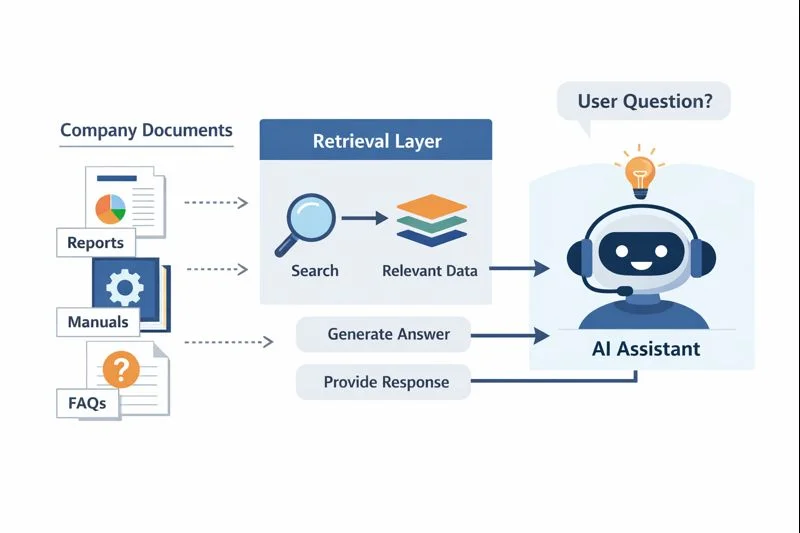
Workflow showing how a RAG chatbot retrieves document data before responding
A RAG-based system works differently.When a user asks a question, the system first searches through relevant documents. It retrieves the most useful sections based on meaning, not keywords alone. Only then does it generate an answer using that retrieved content.
This approach has three major benefits.
- Accuracy improves because answers are grounded in real text.
- Answers stay current because the system retrieves the latest version of documents.
- Trust increases because responses reflect approved sources.
The assistant is no longer guessing. It is referencing.
Turning documents into a usable knowledge source
Not all documents are ready for RAG out of the box.Companies often store information in long PDFs, scanned files, or loosely structured folders. For RAG to work well, documents need some preparation.
This usually involves:
- Cleaning formatting and removing duplicates
- Splitting documents into logical sections
- Adding basic metadata like document type or department
- Defining which sources are authoritative
This step is often overlooked, but it has a major impact on answer quality.A well-prepared knowledge base leads to clear, consistent responses. A messy one leads to confusion.
Where companies use RAG-based assistants successfully

Enterprise AI assistant helping teams access internal knowledge and SOPs

RAG is especially useful in environments where accuracy matters more than creativity.Common examples include:
Internal operations
Employees use assistants to find procedures, policies, or onboarding information. Instead of searching folders or asking colleagues, they get direct answers grounded in official documents.
Customer support
Support teams reduce ticket volume by letting customers ask questions directly against help articles, manuals, and FAQs. Answers stay aligned with what support teams actually provide.
Compliance and quality
Teams use assistants to reference standards, audit requirements, or controlled documents. The assistant becomes a guided interface to approved material.
Training and enablement
New hires ask questions without interrupting senior staff. The assistant pulls answers from training materials and SOPs.
In all of these cases, reliability matters more than personality.
Why RAG alone is not enough
While RAG improves accuracy, it does not solve everything. A system that only retrieves documents can still feel limited. It may answer correctly but fail to take action.
For example:
- It explains how to submit a request but cannot submit it
- It shows a process but cannot trigger the workflow
- It provides information but cannot escalate issues
This is why many companies combine RAG with automation and conversational logic.
A RAG-based chatbot connected to internal systems can answer questions and then act on them. It can guide a user, collect inputs, retrieve documents, and trigger workflows when needed.
This is typically implemented using a RAG-based chatbot connected to internal docs and backend systems, so the assistant becomes both informative and operational.
Designing conversations around documents
Another common mistake is letting users ask completely open-ended questions without guidance. Even with RAG, structure helps.
Good implementations guide users through:
- Clarifying questions
- Document selection
- Context narrowing
- Follow-up steps
This makes responses more precise and reduces ambiguity. It also improves user confidence in the system. The assistant does not feel restrictive. It feels helpful.
Maintaining trust and control
One concern companies often have is control.
- Who decides which documents are used?
- What happens when documents conflict?
- How are updates handled?
RAG systems work best when ownership is clear. Documents should have owners. Updates should follow a process. The assistant should only reference approved sources.Some teams also add logging and visibility, so answers can be reviewed and improved over time.
Trust grows when people understand how the assistant works and where answers come from.
Measuring success
A reliable AI assistant should reduce friction, not create more work.
Success is usually measured through:
Reduced support tickets
- Faster internal responses
- Fewer repeated questions
- Higher user confidence
- Less time spent searching for information
When these metrics improve, the assistant is doing its job.
Final thoughts
RAG is not a trend. It is a practical solution to a real problem. Companies want AI assistants that answer correctly, stay up to date, and reflect official knowledge. RAG makes that possible by grounding responses in actual documents instead of assumptions.
When combined with thoughtful document preparation, structured conversations, and automation, RAG turns static files into a reliable assistant that people actually trust. The result is not a smarter chatbot.It is a more dependable one.

How to Plan a Last-Minute Holiday Trip with Instant Loan Support

Turning Cash Flow Into Confidence

Sales Forecasting as a Growth Lever: How Modern Sales Forecast Software Offers Revenue Intelligence to Accelerate What Matters







Holistic Advice for Someone Looking to Reduce Stress

The Core Pillars of AI Observability: Metrics, Traces, Logs, and Beyond

The Core Pillars of AI Observability: Metrics, Traces, Logs, and Beyond
RAG Explained Simply: How Companies Turn Documents Into Reliable AI Assistants

How to Build Your Own AI Solutions for Business