In today’s fast-moving digital world, businesses face a critical choice: keep maintaining aging legacy systems or embrace modern applications built for the future. The stakes are high. Legacy systems carry years of valuable data and business logic, but they struggle to meet the speed, intelligence, and experience that users now expect.
This is where application modernization services, UI design services, and generative AI development services come together to make a real difference.
The Problem With Legacy Applications
Legacy applications were built for a different era. Many still run core business operations processing transactions, managing records, powering supply chains. But their age comes with a growing cost.
Security gaps widen every year. Integration with modern tools becomes painful. And the user experience? It remains stuck in the past. Employees waste hours navigating clunky, outdated interfaces. Customers abandon digital journeys that feel slow and frustrating.
Poor UX in enterprise software alone costs organizations over a billion dollars annually in lost productivity. The legacy application problem is not just a technology issue it’s a people issue.
What Application Modernization Services Actually Do
Modernization is not simply rewriting old code. Professional application modernization services offer a range of strategic approaches:
- RehostingMoving apps to the cloud quickly without redesigning them
- ReplatformingMaking targeted upgrades to use cloud benefits
- RefactoringRestructuring code to improve performance and maintainability
- RebuildingRedesigning from scratch using microservices and modern architecture
- ReplacingRetiring legacy systems in favor of modern platforms entirely
The right approach depends on your business goals, budget, and risk tolerance. What matters most is expert planning and a thorough understanding of the existing system’s logic before a single line is changed.
UI Design Services: Connecting Technology to People
Upgrading your tech stack without redesigning the user interface is only half the job. An application running on modern infrastructure but wearing a 1990s interface has not truly been modernized.
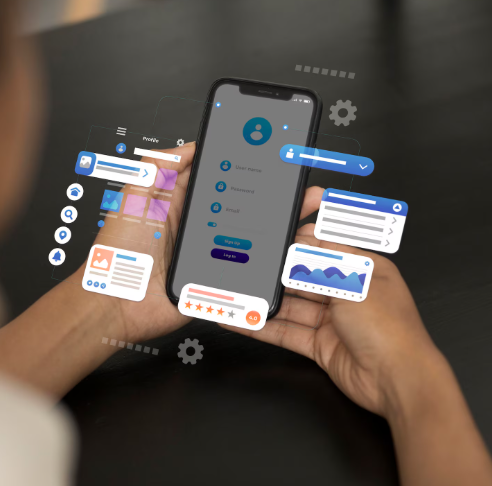
This is where UI design services become essential. Modern UI design combines user psychology, data analysis, accessibility standards, and brand strategy to create experiences that feel natural and effortless. The best design teams start with deep user research not just what users do, but where they struggle and why.
Key principles include:
- Design systemsthat ensure visual consistency across the entire application
- Accessibility-firstdesign that meets WCAG standards and expands your user base
- Mobile responsivenesssince over 60% of enterprise users now work on mobile devices
- Data-driven iterationusing heatmaps, session recordings, and A/B testing to refine the experience
Organizations that invest in quality UI design during modernization projects consistently see higher user adoption, lower training costs, and better employee satisfaction scores.
Generative AI Development Services: The New Competitive Edge
If UI design modernizes how people interact with applications, generative AI transforms what those applications can actually do. Generative AI development services are enabling a new class of capabilities:
Intelligent content generation Applications can now draft reports, compose emails, generate product descriptions, and write code all based on real-time context and user intent.
Conversational interfaces Instead of clicking through complex menus, users can simply ask: “Show me all overdue invoices from last quarter.” Natural language interfaces powered by large language models make this possible.
Predictive analytics Generative AI goes beyond reporting the past. It anticipates supply chain disruptions, flags customer churn before it happens, and recommends the next best action for sales teams.
Intelligent automation Combined with process automation, generative AI handles judgment-intensive tasks like contract review, compliance checking, and customer support with far greater accuracy than rules-based systems alone.
The most forward-thinking organizations are embedding generative AI into the core of their modernized applications, not just bolting it on as a feature.
When All Three Come Together
The most successful modernization programs do not treat these as separate projects. They integrate application modernization services, UI design services, and generative AI development services into one unified strategy where each discipline amplifies the others.
Picture a financial services firm modernizing its loan origination platform. The modernization team migrates the legacy system to cloud-native architecture. The UI team reduces a 47-step process to just 12 intuitive steps. And the AI team embeds an assistant that pre-populates forms from uploaded documents, flags credit anomalies, and generates compliance summaries automatically.
The result is not just a modernized app. It is a fundamentally better business process faster, more accurate, more compliant, and far more satisfying for everyone involved.
The ROI of Getting This Right
The business case for modernization is clear:
- Legacy systems can consume up to 80% of IT budgets in maintenance alone modernization cuts this to 20–30%
- Modern CI/CD pipelines enable weekly deployments instead of quarterly releases
- Superior UX drives a 5% improvement in customer retention, which can increase profits by up to 95%
- Generative AI personalization has driven 15–30% revenue increases in e-commerce and financial services
Conclusion: The Cost of Waiting
The gap between legacy and modern applications grows wider every year. Organizations that delay are not standing still; they are actively falling behind. Competitors are shipping faster, serving customers better, and making smarter decisions powered by AI.
With the right partner delivering integrated application modernization services, transformative UI design services, and intelligent generative AI development services, businesses can modernize at their own pace, reducing risk while accelerating results.
The question is no longer whether to modernize. It is whether you can afford to wait.
Frequently Asked Questions
Q1. How do I know if my system needs modernization or just maintenance?
If your app can’t integrate with modern tools, suffers frequent downtime, can’t scale, or frustrates users daily maintenance alone won’t fix it. A formal legacy assessment will evaluate your system against business goals and total cost of ownership to recommend the right path.
Q2. How long does application modernization take?
It depends on the scope and strategy. A simple rehosting project can take 2–4 months. A full rebuild of a complex enterprise system may take 12–24 months. Agile approaches can deliver real business value within the first 6–8 weeks, even before the full transformation is complete.
Q3. Can UI design be improved without rebuilding the entire system?
Yes. A modern interface can be layered on top of an existing legacy backend a technique called a UI facade. Users get an immediately better experience while backend modernization continues in parallel. It’s one of the most effective ways to show quick wins to stakeholders.
Q4. How is generative AI different from traditional AI?
Traditional AI recognizes patterns and makes predictions based on structured data. Generative AI creates new content, understands natural language, reasons through complex problems, and engages in meaningful dialogue. In enterprise apps, it can draft documents, answer nuanced questions, and handle tasks that previously required human expertise.
Q5. How do we keep data secure when using generative AI?
Security must be built into the architecture from day one. Reputable generative AI development services providers implement data isolation, role-based access controls, and audit logging. For regulated industries like healthcare and finance, AI models can be deployed within private cloud environments to ensure full data sovereignty and compliance.
The AI Skills Gap Is Growing and Here's How Companies Are Closing It.
The Hidden Half of AI Image Creation – Editing, Iteration, and Control

Traditional Tools vs. HOZO Design Laser Measuring Devices