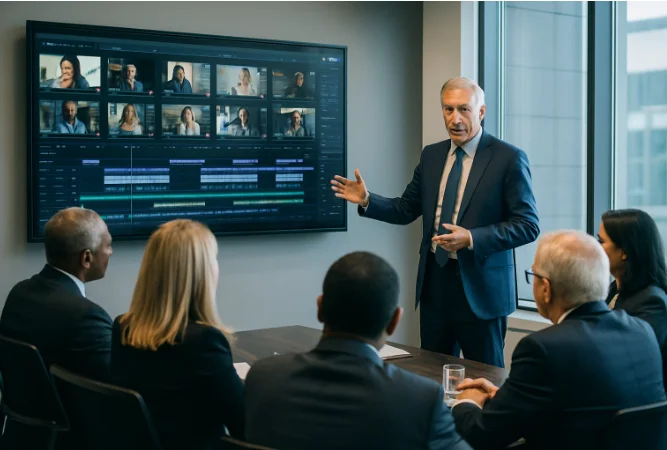
Open any business feed and the pattern is hard to miss: launch clips, customer stories, internal explainers – all produced faster and cheaper than classic studio work. A new generation of tools can turn a short brief into a finished video in minutes. A marketer with access to a free AI video generator can now test a week’s worth of ideas before lunch. Platforms like GoEnhance AI give non-specialists enough control to storyboard, refine and publish without waiting in line for a dedicated production team.
That shift sounds technical, but the real consequences sit on the leadership agenda: how your brand speaks, how quickly your people learn, and how well you control risk in a world where video can be manufactured on demand.
Senior teams that treat this simply as “new software for marketing” are already behind. The conversation has moved to speed of execution, quality control and trust.
Where Leaders Are Quietly Winning with AI Video
The most effective uses aren’t the glossy brand films built to win awards — they’re the practical, low-key deployments that move the work forward. They are the steady, repeatable pieces of communication that previously died in slide decks or long email threads.
A few patterns keep showing up across organizations:
| Scenario | Practical upside | What happens if you ignore it |
| New-hire onboarding and training | Faster roll-out of processes; consistent messaging | Patchy understanding, slower behaviour change |
| Sales and product walk-throughs | Clear demonstrations tailored by industry or region | Prospects depend on PDFs and guesswork |
| Messages from senior leadership | Human updates without the logistics of studio shoots | Rumours and fragments fill the gap in official comms |
| Event and social micro-content | Quick testing of story angles and calls-to-action | High spend on a handful of “big bet” campaigns |
None of this removes the need for human storytellers. Someone still has to decide what the story is and why it matters. What changes is the amount of friction between idea and finished asset: resizing, trimming, translation, version control – the work that used to eat time and budget.
The Trust Problem You Can’t Delegate
The same technology that lets your team spin up a product teaser in an afternoon can also fabricate a speech you never gave. Deepfakes, manipulated clips and non-consensual content are no longer fringe issues. Regulators, journalists and civil-society groups are asking tough questions about how these tools are used and who is accountable when they go wrong.
For a leadership team, this is not an abstract ethical debate. It is reputational risk. Once customers or employees start to wonder whether a clip is genuine, every future message has to work harder.
Three habits help keep trust on your side:
- Be open about what’s generated. A short note in the description or on-screen is usually enough. People don’t need the technical details, they just shouldn’t feel tricked.
- Decide your red lines early. For example: no synthetic clips of real executives saying things they never said; no re-creation of public figures; no use of sensitive incidents as “test content.”
- Treat output as draft, not fact. Someone with brand and legal responsibility should review anything that goes on official channels, just as they would for a written statement.
Putting Some Order Around Experimentation
Most companies are already experimenting with AI video in pockets: a sales team here, a product marketer there, a frustrated HR manager trying to improve onboarding. Without some light structure, that energy quickly becomes chaotic.
A simple internal framework often works better than a thick policy document:
- People. Many employees can try ideas; a smaller group has authority to approve; only a few can publish to official channels. Everyone knows where they sit.
- Tools. Choose at least one platform that’s been vetted for security, data practices, and proper licensing. If you don’t, teams will quietly use whatever they find on the open web.
- Data. Spell out which footage, customer stories and internal materials are safe to use. Anything regulated or sensitive should be excluded by default.
- Results. Define what “good” means in numbers: shorter production cycles, more localized versions shipped, higher completion rates on training videos, better engagement on product pages that use video.
When these basics are written down and reinforced in team meetings, people stop guessing what is allowed and start focusing on outcomes.
A Clear, Realistic 90-day Timeline You Can Actually Follow
Leaders don’t need a three-year roadmap to get started. A focused quarter is enough to move from scattered experiments to a working system.
Month 1 – Understand what is already happening
Talk to teams in marketing, HR, product and customer success. Where are videos already being generated? Which clips are actually being used with customers or staff? Map a few promising use cases that clearly support revenue, cost savings or culture.
Month 2 – Run two or three controlled pilots
Pick narrow, visible problems: a training series for one role, a set of how-to clips for a single product, or monthly leadership updates. Agree in advance on guardrails, tone of voice and success metrics. Capture what the teams learn: which prompts worked, where human editing was essential, what caused re-work.
Month 3 – Decide what becomes “business as usual”
Scale only the pilots that produced real value and didn’t create headaches for legal or IT. Document the workflow and nominate owners. Then communicate the plan internally so employees understand that the goal is to help them work faster and express ideas more clearly, not to replace them.
This simple rhythm – observe, pilot, standardize – is familiar to most operations or transformation leaders. Video just happens to be the field where it now applies.
What Will Still Set You Apart Once Everyone Has Access to AI Video
Soon, access to powerful video tools will not be a differentiator. Your competitors will have them; your partners and suppliers will have them; your candidates will use them in job searches and personal branding.
The advantage will sit elsewhere:
- in the clarity of the stories your organization chooses to tell
- in the confidence and skills of the people asked to tell them
- in the courage to set boundaries before a crisis forces the issue
- in the discipline to read the numbers and shut down experiments that don’t deliver
It is easy to see these tools as a shortcut to creativity. In practice, they are a way of turning decisions into visible action at high speed. Strategy, values and taste still come from the people at the top.
The leaders who thrive will not be the ones with the most spectacular synthetic promos, but the ones who quietly use this new capability – supported by practical, accessible tools like https://www.goenhance.ai – to communicate more often, train more effectively and build more trust inside and outside their organizations.
How to Recover WhatsApp Data from iPhone

How Technology is Changing the Way Children Learn — and Why That Matters

What Are the Best Small Hearing Aids for First-Time Buyers?