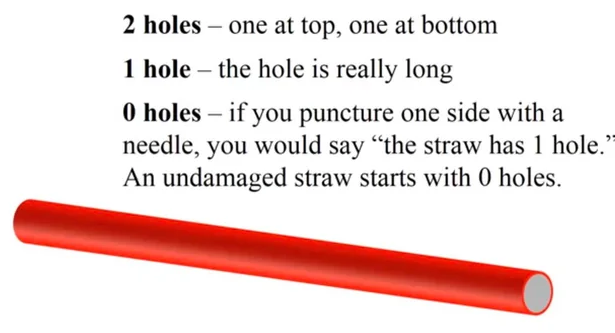
The question how many holes does a straw have might seem simple at first glance, but it has sparked considerable debate among science enthusiasts, educators, and casual thinkers. Straws are ubiquitous drinking tools, yet their design raises intriguing questions in geometry, topology, and everyday physics. The discussion often centers around whether a straw is considered to have one continuous hole running through it or two separate openings at each end. Exploring this topic provides insight into mathematical thinking, scientific reasoning, and the perception of everyday objects.
The Structure of a Straw
Anatomy and Function
A straw is essentially a cylindrical tube, typically made from plastic, paper, metal, or silicone. Its primary function is to facilitate the transfer of liquid from a container to the mouth efficiently. Despite its simple appearance, a straw’s design includes two visible openings, which may lead one to believe it has two holes. However, understanding the concept of a “hole” in topology is crucial to answering the question accurately.
Also explore WellSky Kinnser: Complete Guide to the Home Health Software
What Constitutes a Hole?
In mathematics and physics, a hole is defined as a passage through a surface or object that interrupts its continuity. From this perspective, a straw can be seen as a single elongated hole with two endpoints. The entire cylindrical passage functions as one continuous tunnel, which is why some argue that a straw has only one hole rather than two. This interpretation relies on geometric principles and the idea of continuity in physical objects.
Perspectives on How Many Holes a Straw Has
Single-Hole Interpretation
Supporters of the single-hole view assert that the straw’s tube is one continuous hollow structure. The two ends are simply openings of the same hole. This aligns with concepts in topology, where objects like toruses, doughnuts, and tubes are often described based on their single continuous holes rather than discrete entrances or exits.
Double-Hole Interpretation
Others argue that since there are two distinct openings—one at the top and one at the bottom—a straw has two holes. This perspective treats holes as individual entry points rather than as a continuous tunnel. This interpretation is more intuitive for everyday observation but less consistent with topological definitions.
Educational and Scientific Implications
The debate over how many holes does a straw have has educational value. It introduces students and curious minds to critical thinking, encourages discussion about definitions in mathematics and physics, and illustrates how context can change perception. Teachers often use this question to stimulate engagement in STEM activities and develop reasoning skills in geometry and physics.
Practical Considerations
Everyday Understanding
For most people, whether a straw has one or two holes does not impact its function. A straw serves the same purpose regardless of the topological interpretation. However, exploring this question promotes awareness of structural design, fluid mechanics, and the nature of objects in our environment.
Influence on Design and Engineering
Understanding the geometry and structure of hollow objects can be applied in engineering, plumbing, and industrial design. Concepts learned from analyzing a straw’s hole structure can extend to designing tubes, pipes, and channels in various scientific and manufacturing applications.
FAQs
1. Why is there debate about how many holes a straw has?
The debate arises because a straw has two openings, but its internal tunnel is continuous. Different interpretations of “hole” lead to differing opinions.
2. Can topology help answer this question?
Yes. Topology considers continuous spaces, and from this perspective, a straw has one elongated hole regardless of its two ends.
3. Does the material of a straw affect the number of holes?
No. The number of holes depends on structure, not material. A plastic, paper, or metal straw all have the same hole configuration.
4. Is this question purely academic or does it have practical use?
While often discussed academically, it also encourages critical thinking, spatial reasoning, and understanding of fluid pathways in engineering and design.
5. Can other objects be analyzed similarly?
Yes. Tubes, pipes, doughnuts, and tunnels can be analyzed in the same way, using topology and geometry to determine the number of continuous holes.
Conclusion
In conclusion, the question how many holes does a straw have serves as both a playful curiosity and a gateway into deeper scientific and mathematical concepts. While everyday intuition might suggest two holes, topological and geometric analysis shows that a straw is more accurately described as having one continuous hole with two openings. Exploring this topic enhances understanding of spatial reasoning, mathematical definitions, and the fascinating complexity hidden in ordinary objects. This simple question illustrates how science and mathematics can transform everyday observations into meaningful insights.

Plumber: A Comprehensive Guide for Home Renovation Projects

Pin Travels: Your Gateway to Worldly Adventures

ItsNewzTalkies: Your Ultimate Guide to Digital Media